Companies that cut 40% of their meetings gain 71% more productivity. The problem was never the work. It was the calendar.
By Ricardo Fernandes ·
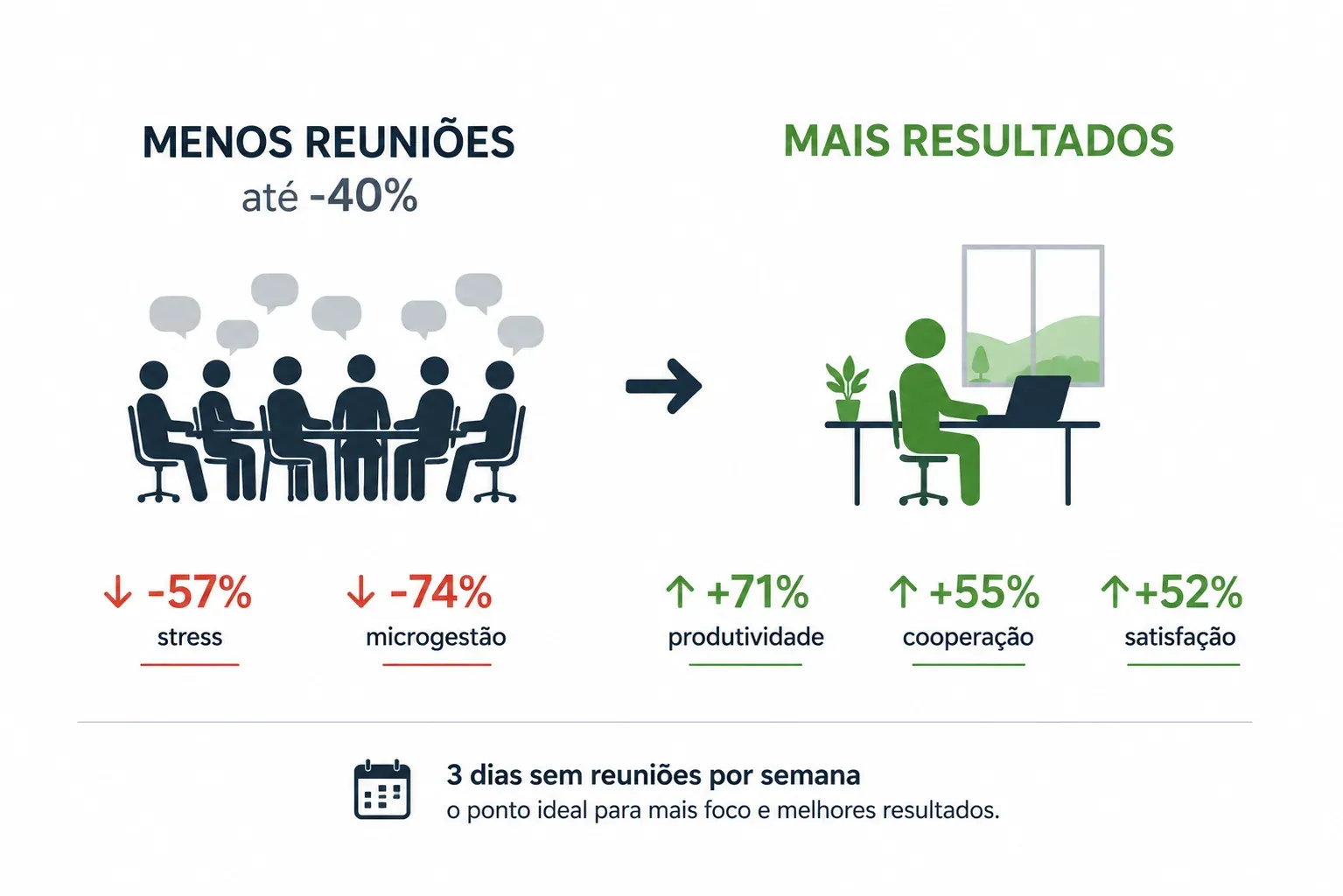
Companies that introduced meeting-free days managed to cut meetings by up to 40%. The result: 71% more productivity, 55% more cooperation, 52% more satisfaction. And drops of 57% in stress and 74% in micromanagement.
These numbers do not all come from the same scenario: the study compared companies with a different number of meeting-free days a week, and each result depends on that number.
This isn’t a consultant’s opinion. It’s the result of academic research published in MIT Sloan Management Review on one of the most ingrained habits of modern work: filling the calendar with meetings.
The problem was never the work
Most organisations measure productivity by what people do after hours, or in the margins of the day. What the data shows is simpler and more uncomfortable: the problem isn’t a lack of time to work. It’s time hijacked by meetings that should never have existed.
When companies remove that burden, even if only one or two days a week, productivity doesn’t rise slightly. It rises dramatically. This suggests that much of the meeting load wasn’t generating value proportional to the time it consumed. It was just filling the calendar.
What happens when space opens up
The numbers that stand out most aren’t just the productivity ones. They’re the ones on cooperation and stress. Cutting meetings increased cooperation by 55% and reduced stress by 57%. This runs against the most common intuition, that fewer meetings means less alignment, less communication, more isolation.
The opposite happens. When people are no longer constantly interrupted by back-to-back meetings, they have mental space left to collaborate more intentionally, instead of reacting from one meeting to the next.
Micromanagement drops too
One of the most revealing figures is the 74% drop in micromanagement. This points to something structural: many meetings don’t exist to solve problems, they exist so the manager can keep visual control over what the team is doing. When that daily control disappears, managers are forced to trust the team’s autonomous work more, and that, in itself, changes the power dynamics within the group.
Where the limit is
The study itself is clear on one important point: eliminating all meetings is counterproductive. It reduces communication and engagement. The best results came with about three meeting-free days a week, not with cutting them entirely. The point was never to get rid of meetings. It was to stop using them as the automatic default for any topic, however small.
Why this keeps happening
If the numbers are so clear, why do most organisations keep filling the calendar? Because scheduling a meeting feels productive. It gives the sense that something is being done, even when the real result is weaker than it would have been with a shared document, or a decision made by one person with enough context to make it alone.
The question that remains
If you look at your calendar this week, how many of those meetings existed to solve something that could only be solved together? And how many existed only because it was Friday and someone thought there should be a status update?