Deciding got more expensive
By Ricardo Fernandes ·

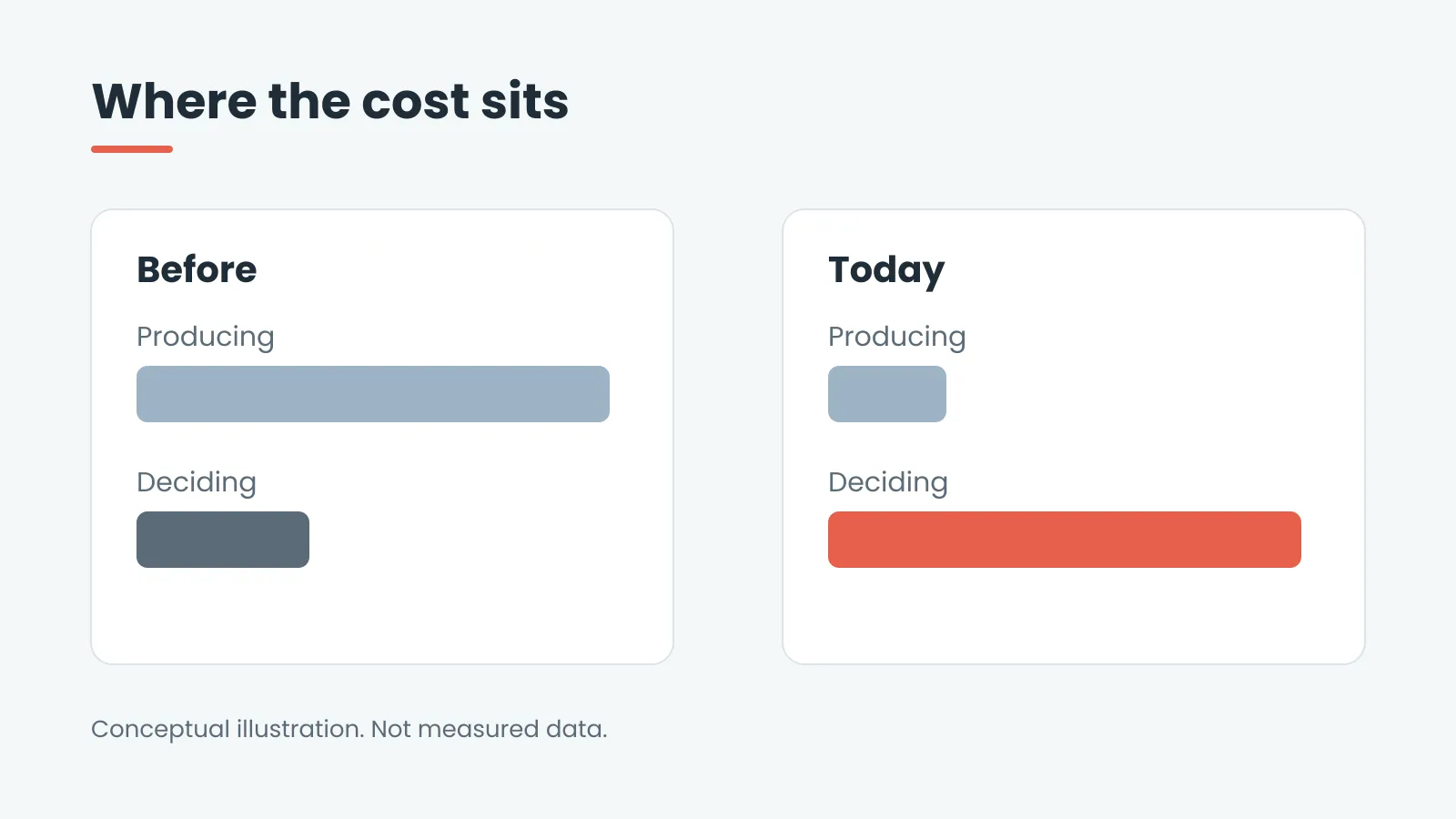
Producing got cheap. And that moved the place where the hard work happens.
The team delivers more than ever. And decisions still drag on.
Today, what used to take days is generated in minutes. A draft. A plan. An analysis. Three versions of each.
This is not a fad. It is not the end of work either.
It is a change in price. And when the price of something falls, the value moves elsewhere.
What got cheap
For a long time, producing was the bottleneck. Getting one proposal on the table cost someone days. A single option was already progress.
AI lowered that cost. Having options stopped being the problem.
The problem became what to do with them.
What got expensive
Three things did not get any faster.
- Choosing. Ten plausible options are not worth ten times more than one. They demand criteria, and criteria are not generated in minutes.
- Reviewing. A well-written text looks right even when it is not. Checking it takes context, and that still costs the time of people who know.
- Owning. Someone has to say “this is the way” and answer for it when it goes wrong. A tool answers for nothing.
And there is a volume effect. Every new version is one more thing to read, compare and validate. Producing one more option costs minutes. Assessing it properly costs what it always did.
The cost did not disappear. It changed hands.
It left those who produce and landed on those who decide.
More volume, same doubt
In the teams I work with, I often see the same pattern.
More output. More meetings to validate it. And accountability that gets blurrier every time.
Everyone contributed. Nobody decided.
The signs are easy to recognise. The document passes through several people and none can say who approved it. The meeting ends with “let’s come back to this”. The decision happens by default, when the deadline no longer leaves a choice.
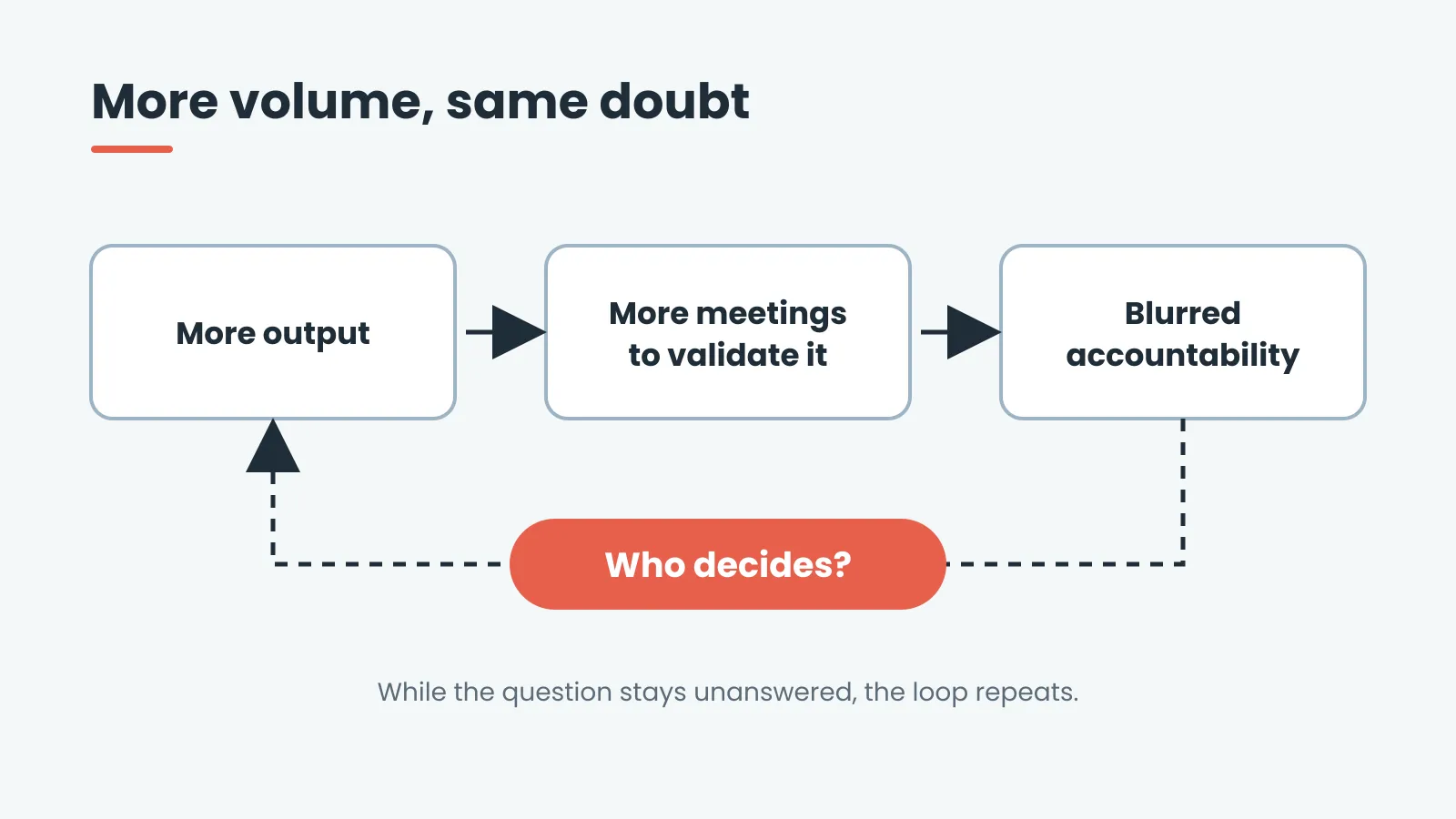
This is not a method problem. It is not a tool problem either.
It is a problem of decision maturity.
What does not fix it
The usual reaction is to add layers.
- More validation meetings. They gather more opinions. They do not say who closes.
- More levels of approval. Each extra signature dilutes responsibility instead of strengthening it.
- One more tool. It speeds up producing, which was already the fast part.
None of these responses is wrong in itself. The trouble is that they all treat the decision as a lack of information.
Often, the information has already arrived. What is missing is someone who says “this one is mine”.
What changes for those who lead
When producing was expensive, it made sense to follow execution closely. That was where the risk was.
Today the risk sits elsewhere. Controlling in detail something that takes minutes is spending attention in the wrong place.
What counts now:
- Explicit criteria. Say, before producing, what “good enough” means and what is not negotiable. Without criteria, every new version reopens the discussion.
- A clear owner. Every relevant decision has a name. Not a committee, a name.
- Limits of autonomy. The team knows what it decides alone, what it decides after consulting and what goes up.
- The courage to close. Choose with incomplete information and say so out loud. Postponing is also deciding, only without an owner.
None of this is new. What changed is the price of not doing it. With more volume, a decision without an owner holds up more work each time.
Less control over execution. More quality in decisions.
Where to start
Take your team’s last important decision and ask three questions.
Who made it? On what criteria? Who answers if it goes wrong?
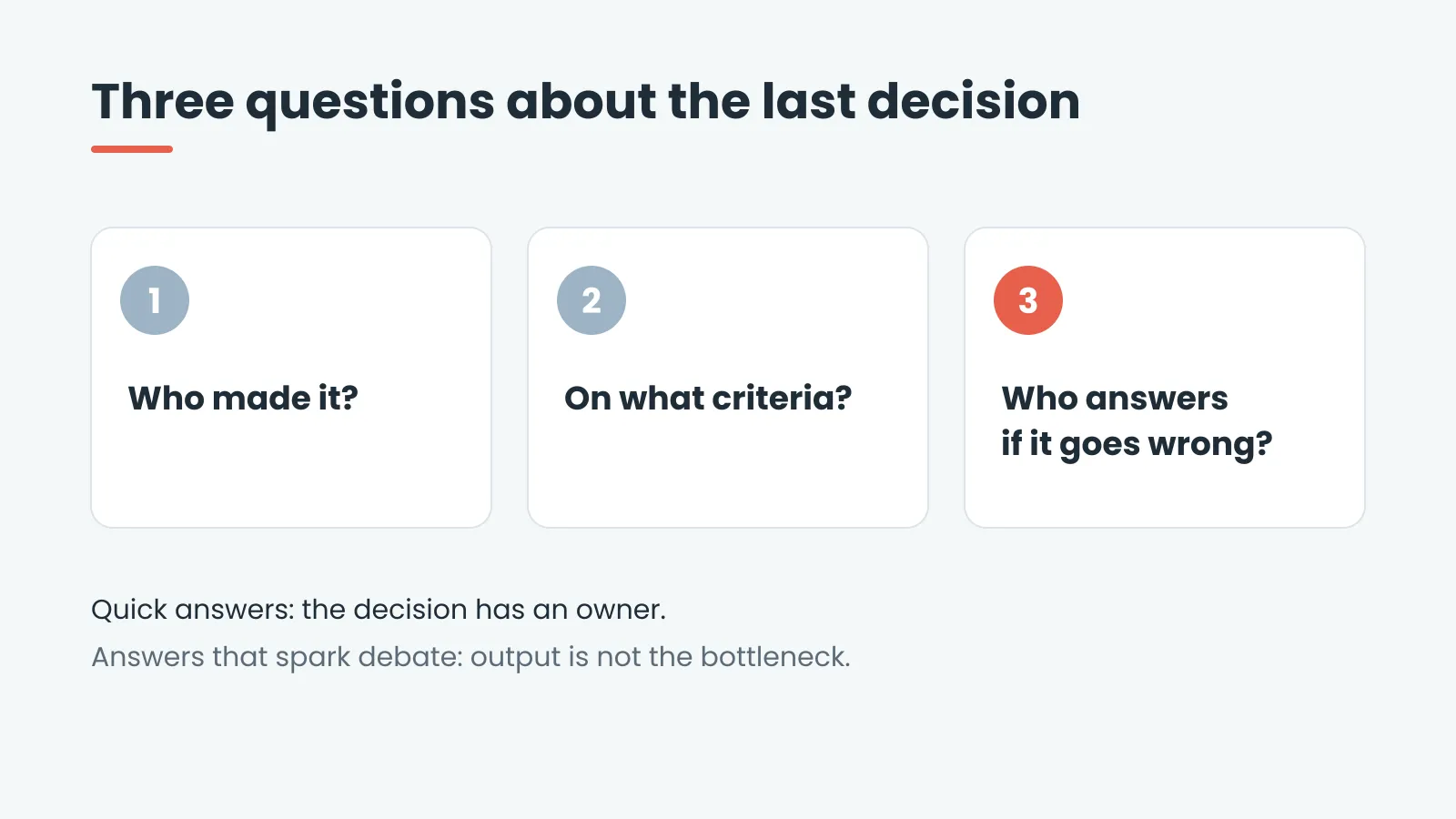
If all three answers come quickly, the decision has an owner. If they spark a debate, output is not the bottleneck.
Then pick a decision that is still open this week. Before asking for one more version, write two lines: who decides and what the criteria are. Only then produce.
It takes ten minutes and needs no new tool.
From argument to practice
This is where Growing Centuries works with leaders and teams: clarifying who decides what, on what criteria and with how much autonomy. It is the focus of our Practical Leadership & Applied AI solution. AI changes the pace. It does not remove the decision.
Want to see where decisions are getting stuck in your team? Request a diagnosis or get in touch.