Leadership training: the investment paradox
By Ricardo Fernandes ·
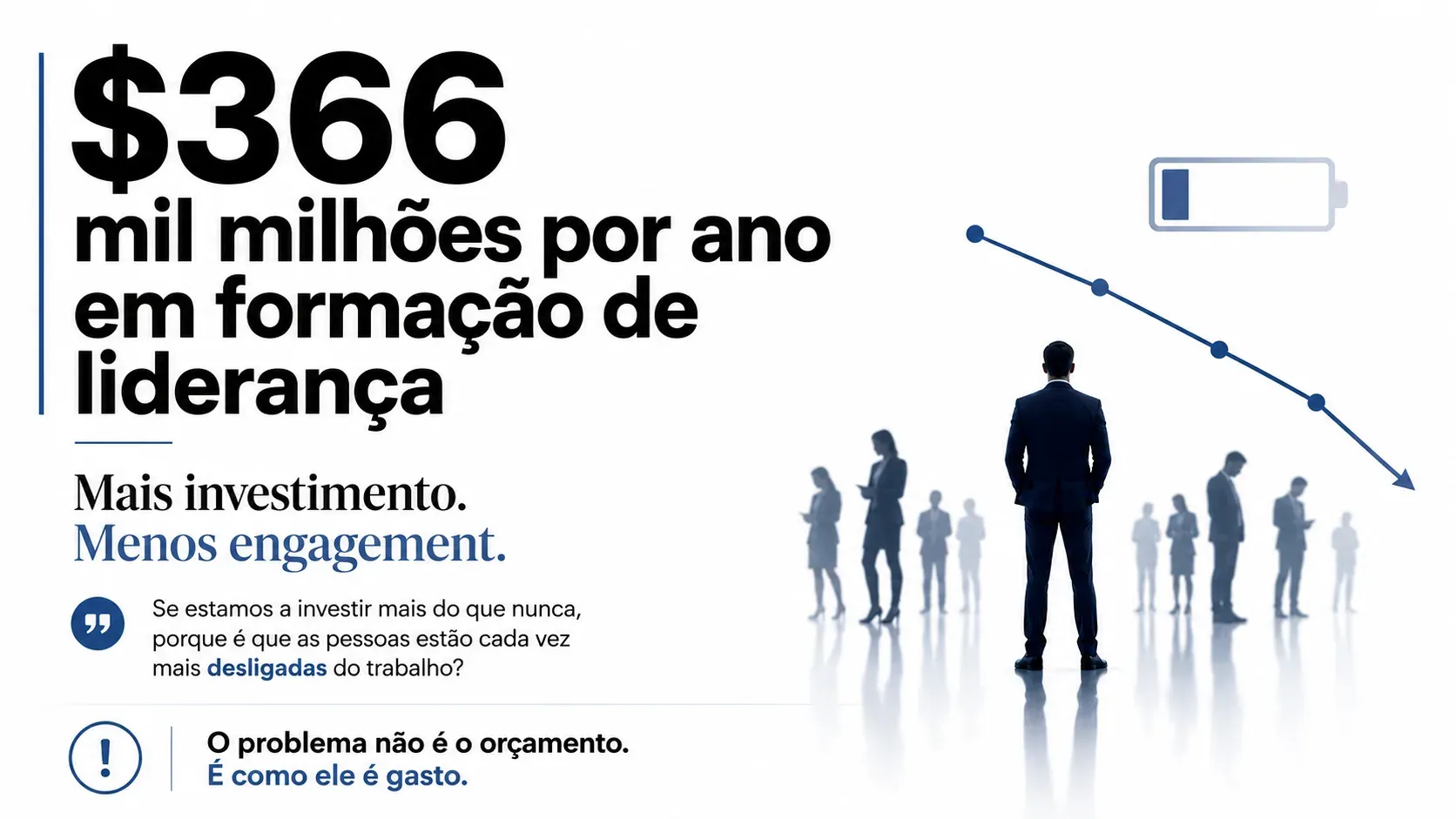
An estimated $366 billion a year goes into leadership training. Engagement at its lowest level since the pandemic. If we’re investing more than ever, why are people becoming more and more disengaged from their work?
The answer isn’t a lack of budget. It’s how that budget is spent.
The problem isn’t the money
If investing in leadership solved the problem, we would have solved it long ago. Companies aren’t holding back. They’re spending more and more, every year, on training programs, workshops, certifications, e-learning platforms, executive coaching. And yet engagement keeps falling.
This should bother more people than it does. Because the implicit logic behind all this investment is simple: more training, better leaders, more engagement. And the numbers say that logic is wrong, or at least incomplete.
Where the leak is
Most leadership training is still designed for a problem that no longer exists in the same form. Generic models, applied to contexts that demand specific answers. Content that is learned in a room (or on a screen) and never actually touches the real day-to-day of someone leading a team under pressure, with tight deadlines and tired people.
There’s a clear symptom of this: most managers still step into their first leadership role without any formal preparation. They learn to lead by doing, by making mistakes, on their own. Training comes later, once habits have already set in, and it often arrives disconnected from the reality those leaders face every day.
Training someone in leadership theory without giving them room to practice, make mistakes and adjust in a real context is like teaching someone to swim with a manual. They may know everything about strokes. They’ll sink in the first pool.
What’s really missing
It isn’t more content. It’s more situated practice, closer support, more room to make mistakes without it costing someone their career. It’s swapping the logic of “a three-day program and a certificate at the end” for the logic of continuous development, built into real work, with frequent and specific feedback.
The organisations that are managing to reverse this trend aren’t necessarily spending more. They’re spending differently: less on generic content, more on close support for managers, especially those stepping into their first leadership role and those feeling the most pressure in the middle of the hierarchy.
The question that remains
If your company invests in leadership and engagement keeps falling, the question shouldn’t be “how much more do we need to invest”. It should be “what are we actually investing in”.
Whatever the exact figure, it is a lot of money to keep asking the same wrong question.