The higher you climb, the more engaged, and the more alone!
By Ricardo Fernandes ·
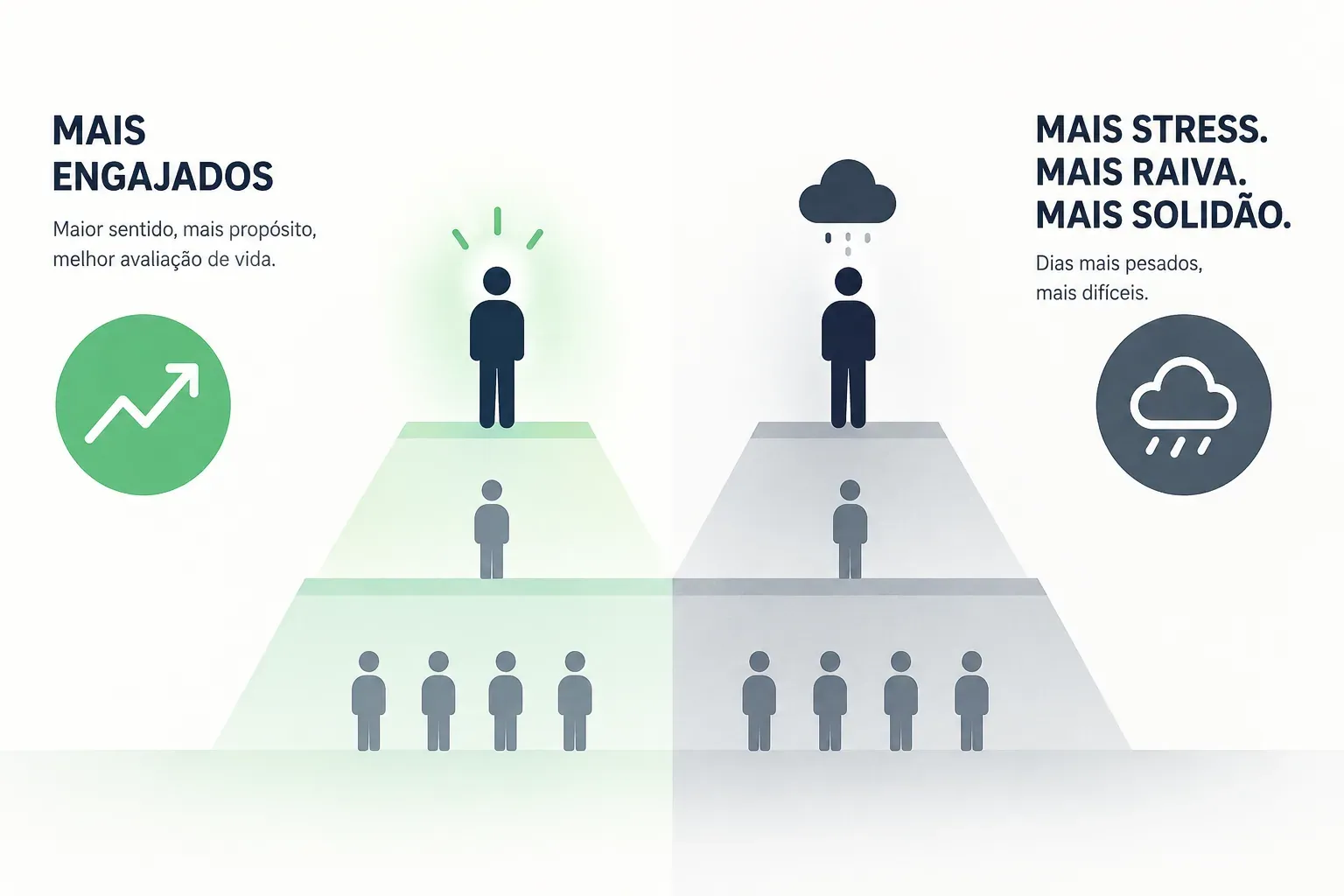
Leaders at the top are the most engaged. And the ones who report the most stress, the most anger and the most loneliness.
This is the kind of data that should stop any conversation about leadership development in its tracks. Not because it’s surprising, “it’s lonely at the top” was a saying long before it was a statistic, but because now it has numbers behind it.
What the data says
Gallup’s State of the Global Workplace 2026 report compared the daily emotional lives of leaders, middle managers and individual contributors. The result is an uncomfortable paradox: leaders have the highest engagement and the best life evaluation. But day to day, they feel more stress, more anger, more sadness and more loneliness than any other group. They are also less likely to say they laughed or smiled the previous day.
In other words, leaders have better lives and worse days.
Two things at once
The most common mistake is to pick one of the two facts and ignore the other. Either you conclude that leadership is rewarding, period, or that leadership is destroying those who lead, period. Neither is the full story.
Leaders describe their work as full of meaning and, in most cases, they truly believe it. What doesn’t show up in that description is the day-to-day wear and tear, which is stored in memory differently from how it was lived. After a while, yesterday’s exhaustion is replaced by the overall narrative of purpose. That’s why this kind of suffering is so easy to ignore, even by the people who feel it.
Why this happens
Gallup itself points to the most direct explanation: leading brings voice, agency and status, but it also brings greater social distance and the responsibility of making hard decisions that affect many people’s lives. It’s not just more work. It’s a different kind of weight, one that is rarely shared, because the very structure of the role pushes the leader into a more isolated position.
The higher up the hierarchy, the fewer people there are to talk to openly about doubts, mistakes and fatigue. And the more people depend on those decisions, the less room there is to show that vulnerability.
What this means for those who develop leaders
If the goal is to develop resilient and effective leaders, ignoring this part of the equation means doing only half the job. It’s not enough to work on technical management skills, strategic vision, communication, decision-making. You need to design spaces where this emotional strain can be named without reputational cost. Where stress, anger and loneliness aren’t treated as personal failings, but as a predictable part of the territory.
This isn’t about adding one more wellbeing workshop to the calendar. It’s about recognising that the isolation of those who lead is structural, not incidental, and that any serious development program has to deal with it directly, rather than pushing the issue over to HR as if it were a separate problem.
The question that remains
If your top leaders are among the most engaged and, at the same time, among the loneliest people in the organisation, what space do they have to say so out loud, without it looking like weakness?