What is a sketchnote
By Ricardo Fernandes ·

It is not a pretty drawing. It is a way of taking notes that makes you listen before you write.
What it is, in two sentences
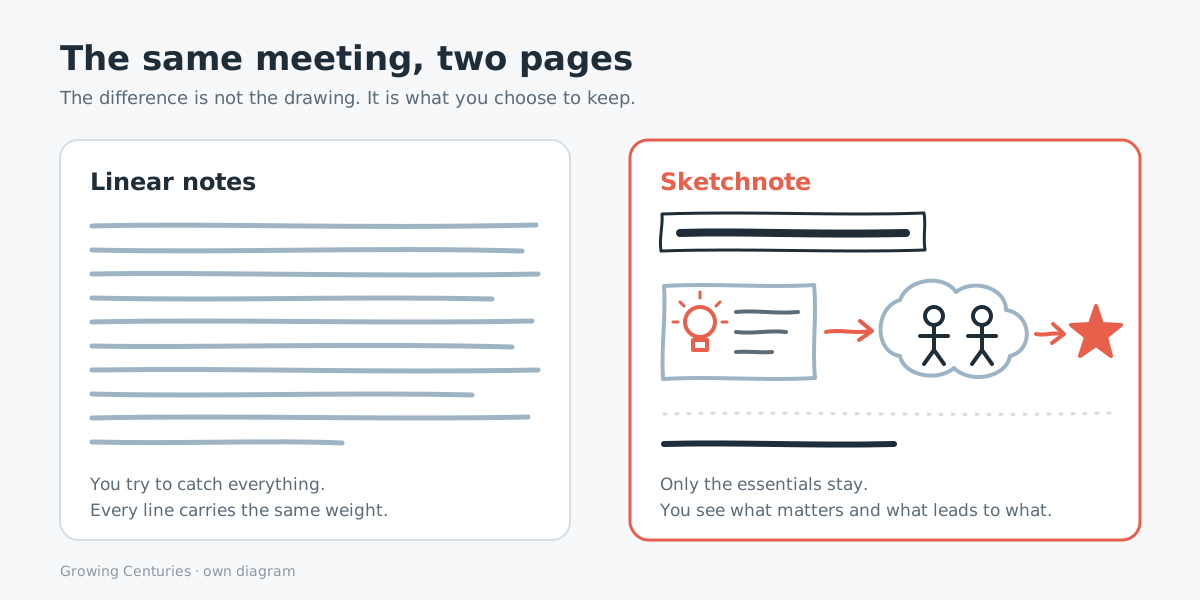
A sketchnote is a page of handwritten notes that combines words and simple drawings to capture the main ideas of a meeting, a class or a book. Instead of trying to catch everything, you choose what matters and give it a shape.
It is not an illustration. It is not a set of minutes.
It is notes. Only with more than one way of showing an idea.
Where it comes from
The term was coined by Mike Rohde, an American designer, in 2007.
Rohde says that by late 2006 note-taking had become a burden. He was writing almost word for word, and still felt he was falling behind and missing the essentials.
At a design conference in the spring of 2007, he changed the rules. He took a pocket notebook and a pen, with no pencil and no eraser. With little space and no way of rubbing anything out, he had to write less, listen more and keep only the big ideas, in words and in images.
He called the result “sketchnotes”. In late 2012 he published The Sketchnote Handbook, the book that gave the practice a vocabulary and a method. The Sketchnote Workbook followed in 2014, with uses beyond conferences.
The idea running through his work fits in three words: ideas, not art.
What problem it solves
Three situations you will probably recognise.
- Notes nobody reads again. Page after page of text, all looking the same. When you need one piece of information, you have no idea which line it is on.
- Writing everything and hearing nothing. Your hand chases the speaker. At the end you have the transcript, but you cannot say what the central idea was.
- Ideas that are hard to explain to others. You followed the reasoning in the room. A week later, trying to pass it on to a colleague, all you have is loose sentences.
These situations have one thing in common. The notes keep the words, but not the relationship between them: what matters most, what leads to what, what belongs together.
How it works
A sketchnote is built from a handful of elements. None of them takes talent. They take choices.
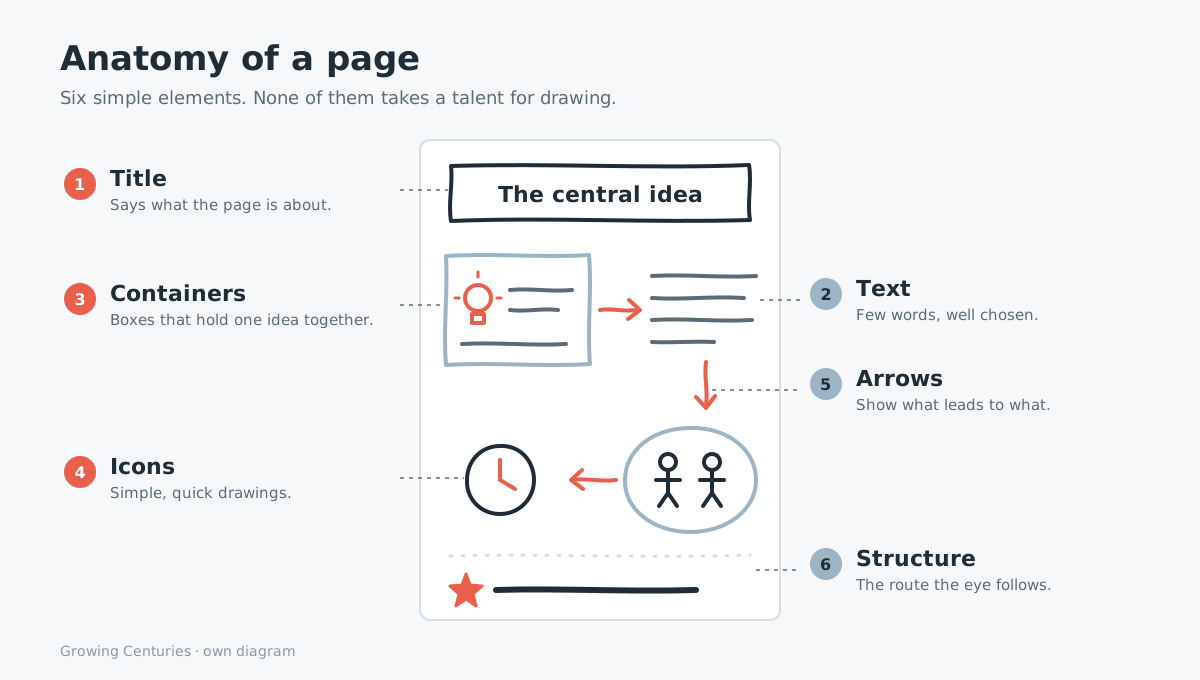
- Text. Your normal handwriting, in short sentences. It still makes up most of the page.
- Titles and lettering. Bigger or bolder letters, to mark the topic and the main ideas.
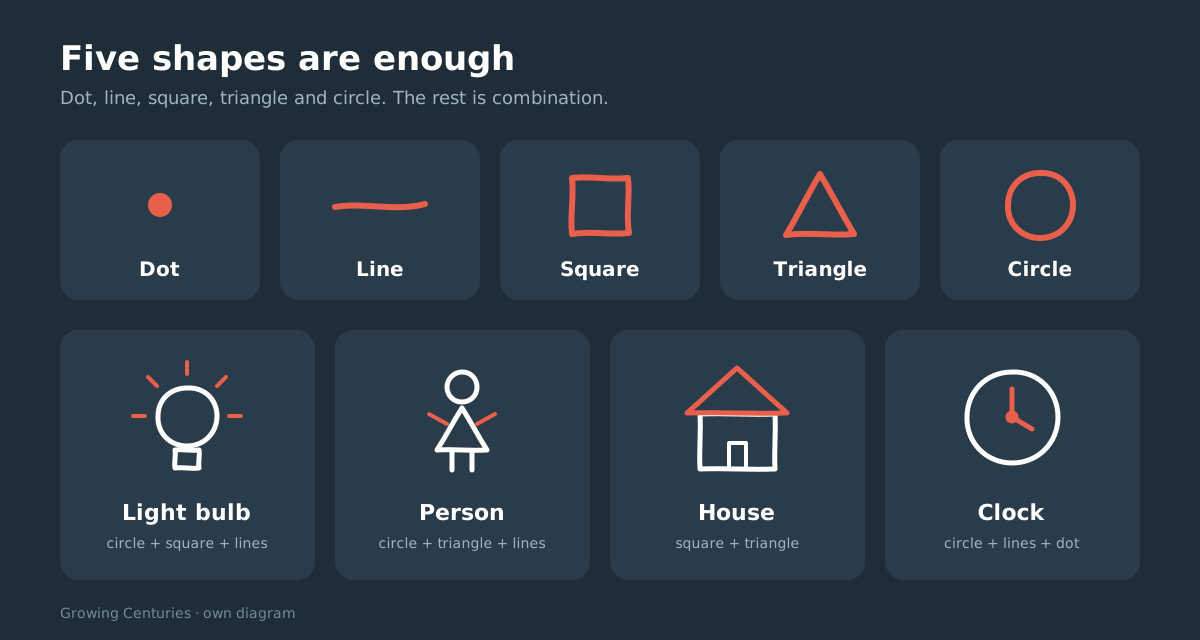
- Basic shapes. Dot, line, square, triangle and circle. Everything else is drawn with them.
- Icons. Small, quick drawings that replace or reinforce a word: a light bulb, a person, a clock.
- Containers. Boxes, speech bubbles and clouds around an idea, to set it apart from the others.
- Arrows and connectors. Lines that show sequence, cause or a link between two ideas.
- Page structure. The route the eye takes: in columns, out from the centre, or along a path.
The part that most surprises newcomers is the basic shapes. If you can draw a circle and a square, you already have what you need.
There is also an order to the work. First you listen. Then you decide what deserves to stay. Only then do you write or draw.
The drawing comes last, and it is the smallest part.
An example
Note: this is an illustrative scenario, built to explain the practice. It does not describe a specific client.
Picture a project manager in a one-hour kick-off meeting, with six people round the table. She usually leaves these meetings with three pages of continuous text. This time she brings a single A4 sheet and a pen.
At the top she writes the project name, in big letters. It takes ten seconds and she already knows what the page is about.
During the conversation, she does not record who said what. She records what was decided. Each decision goes inside a box, in four or five words.
When someone mentions the delivery date, she draws a clock next to it. When a risk comes up, a triangle with an exclamation mark. When one decision depends on another, she joins the two with an arrow.
The people are stick figures. The boxes are crooked.
At the end she has a sheet with a title, five boxes, three arrows and half a dozen icons. The next day, a colleague who missed the meeting asks her for a summary. She shows him the sheet and explains the project in two minutes, following the arrows with her finger.
The sheet did not turn out pretty. It turned out useful.
What it is not
- It is not art. The aim is to understand and remember, not to exhibit. An ugly sketchnote you read again is worth more than a beautiful one left half done.
- It does not require knowing how to draw. It requires knowing how to listen and how to choose. The drawing comes down to shapes you learned in primary school.
- It is not graphic recording. That is done in large format, on a wall, in front of a group and for the group. A sketchnote is done in a notebook and, first of all, for the person making it.
- It is not a mind map. It can start from the centre, but it does not have to. The structure adapts to the content.
- It is not about filling the page with doodles. If the icon does not help explain the idea, it is decoration. A page of well-organised text counts too.
The most common mistake is to start with the drawing and forget the listening. A sketchnote with perfect icons and no central idea is a scribble pad.
Where to start
At your next meeting, or the next video you watch, use a single sheet. Write a title, capture three ideas in boxes and join them with arrows. Add an icon if one comes to mind. If it doesn’t, leave it out.
At Growing Centuries, the Sketchnotes training is hands-on from start to finish. You draw from the first few minutes, starting with the basic shapes, and practise on real content. You leave with your first pages done, not just an explanation of how to do them.
- Training page: Sketchnotes at Growing Centuries
- Reference site: rohdesign.com, by Mike Rohde
Want to find out whether sketchnotes make sense for you or your team? Get in touch.