What is Deep Democracy
By Ricardo Fernandes ·

It is not about getting everyone to agree. It is about deciding without throwing away what the minority knows.
What it is, in two sentences
Deep Democracy is a facilitation method for making group decisions and handling tension, one that also listens to those who disagree. It starts from a simple idea: the minority view holds information the group needs in order to decide well.
It is not voting and moving on. It is not arguing until everyone agrees.
It is a set of steps and tools for bringing into the conversation what usually goes unsaid.
Where it comes from
The phrase “deep democracy” comes from Arnold Mindell, a physicist and Jungian analyst, and the founder of Process Oriented Psychology.
The method we are talking about here has a name of its own: Lewis Deep Democracy. It was developed by Myrna Lewis and Greg Lewis, a South African couple, both psychologists, building on Mindell’s work.
The context explains a lot. In the 1990s, as apartheid was coming to an end, the Lewises were called in by one of South Africa’s largest employers. There were teams where, almost overnight, people who had never had a voice were sitting at the same table as those who had always decided.
Mindell’s work came from psychology. The Lewises wanted to make it accessible to people who are not psychologists and simply need to run a meeting. The result was a method in steps.
In 2008, Myrna Lewis published the book Inside the No: Five Steps to Decisions that Last. Today the method is taught on several continents.
What problem it solves
Three situations you will probably recognise.
- The decision was made, but nothing happens. In the meeting, nobody objected. Three weeks later, nothing has moved. The “yes” turned out to be silence.
- The real meeting happens in the corridor. The objections come out over coffee, in private messages, in the car park. In the room, only half the conversation was heard.
- The same people always do the talking. Two or three voices fill the space. The rest nod. Anyone with a doubt assumes they are the only one and keeps quiet.
These situations have one thing in common. The majority decided, and what the minority thought was left under the table. It did not go away. It moved somewhere else.
How it works
The method uses the image of an iceberg. What the group says out loud is the tip. The rest is under water.
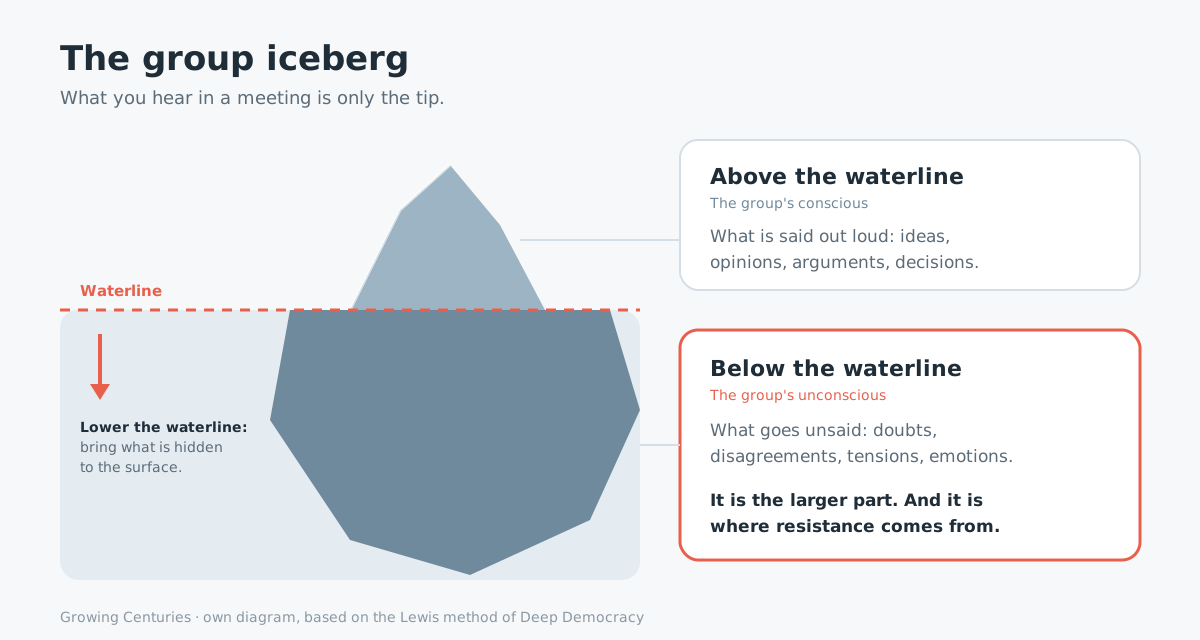
- Above the waterline. The group’s conscious: the ideas, arguments and opinions everybody has heard.
- Below the waterline. The group’s unconscious: the doubts, disagreements and emotions nobody has voiced.
- Lowering the waterline. The facilitator’s job: bringing what is hidden to the surface, at a pace the group can handle.
For decisions, the method offers four steps. When they are not enough, there is a fifth.
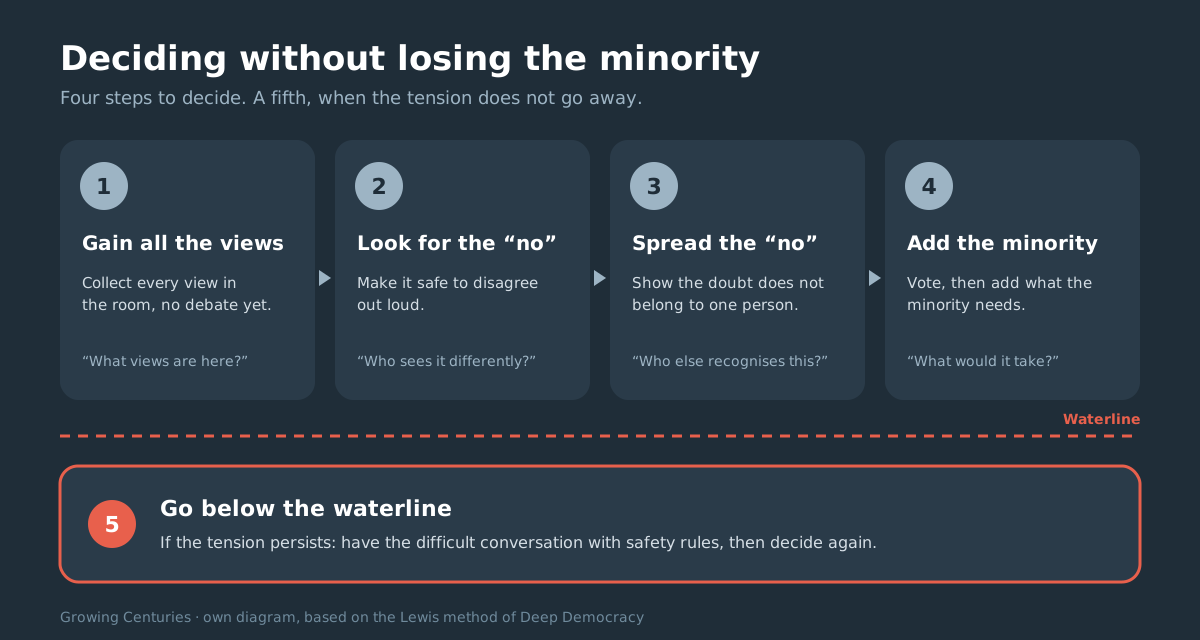
- 1. Gain all the views. Collect the opinions in the room, without debating them yet.
- 2. Actively look for the “no”. Ask whether anyone sees the issue differently, and make it safe to say so.
- 3. Spread the “no”. Ask who else recognises that doubt, so that it stops belonging to one person.
- 4. Add the wisdom of the minority. Vote, then ask those in the minority what they need in order to come along. What they say goes into the decision.
- 5. Go below the waterline. When the tension persists, the group has the difficult conversation in a structured way, with safety rules, and only then goes back to deciding.
One more concept explains why the effort is worth it: the resistance line. A “no” that is not heard does not disappear. It gets louder.
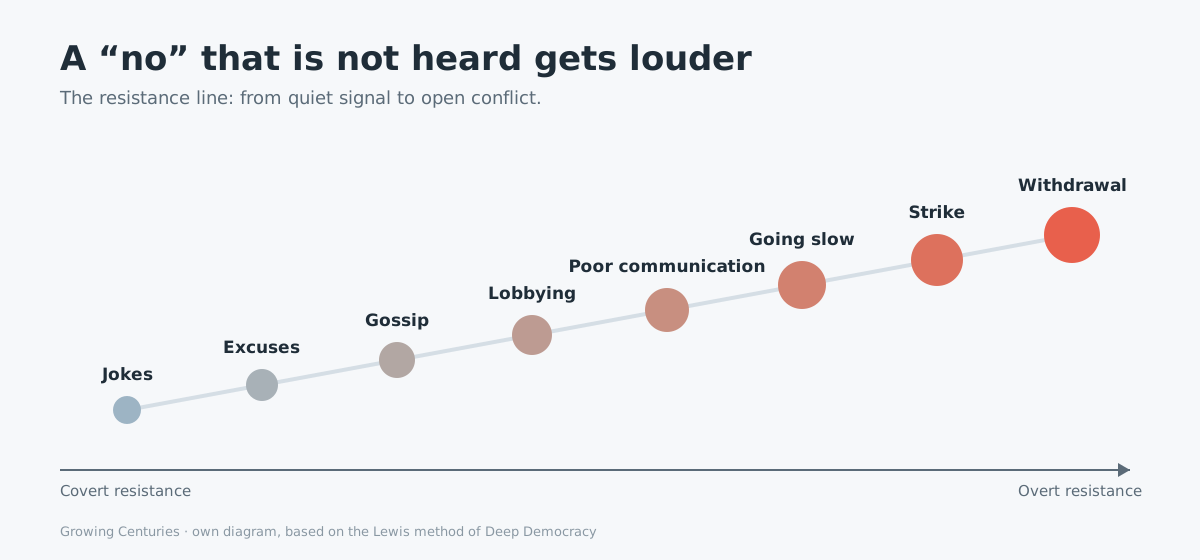
It starts with jokes and excuses. It moves on to gossip and poor communication. It can end in a strike or in withdrawal. The earlier you listen, the cheaper it is.
An example
Note: this is an illustrative scenario, built to explain the practice. It does not describe a specific client.
Picture a sales team of nine people. The director wants to switch customer management systems in January. In the meeting, she presents the proposal and asks whether there are any objections. Silence. Two colleagues look at the table.
Instead of closing the matter, she asks a different question: “Does anyone see this differently?”
One person takes the risk. January is when accounts are closed with customers. Switching systems at that point will cause errors.
The director does not reply or defend the proposal. She asks the room: “Who else recognises a bit of this concern?” Three hands go up. The doubt no longer belongs to one person.
They vote. Six in favour of switching, three against. The proposal passes.
The fourth step is still to come. She asks the three: “What do you need in order to come along with this decision?” The answer is concrete. Start in February, and have someone available for questions during the first two weeks.
The final decision is the majority’s, with two conditions from the minority built in. Nobody left the room thinking “I told you so”.
What it is not
- It is not consensus. The majority still decides. The difference is that the decision carries what the minority needs.
- It is not a right of veto. Those who disagree do not block. They add conditions, information and risks that were missing.
- It is not group therapy. Emotions come in when they are holding up the work. The aim is still to decide and move forward.
- It is not only for serious conflicts. The first four steps work in an ordinary team meeting, on any given Tuesday.
The most common mistake is to ask for the “no” and then defend yourself against it. If the facilitator answers every objection with a counter-argument, the team quickly learns that speaking up is not worth it.
Where to start
At your next team decision, once you have heard the opinions, ask a single question: “Does anyone see this differently?” Then wait, without filling the silence. It is harder than it sounds.
At Growing Centuries, the Deep Democracy training is hands-on from start to finish. You try the tools in a group, not just hear about them. The next dates are on the training page.
- Training page: Deep Democracy at Growing Centuries
- Official site: lewisdeepdemocracy.com
Want to find out whether Deep Democracy makes sense for your team? Get in touch.