What is Kanban
By Ricardo Fernandes ·

It is not a board with sticky notes. It is a way of managing work that starts by making it visible.
What it is, in two sentences
Kanban is a method for managing knowledge work, the kind you cannot see on a workbench: requests, analyses, projects, decisions. It makes that work visible, limits how much of it is in progress at the same time and improves, step by step, the way it gets finished.
It does not replace the process the team already has. It does not require new roles.
It is applied on top of what already exists. And it shows where the work gets stuck.
Where it comes from
The word is Japanese and means, literally, something like “signboard” or “sign”. Its origin is at Toyota, where the engineer Taiichi Ohno developed a system of cards to control production.
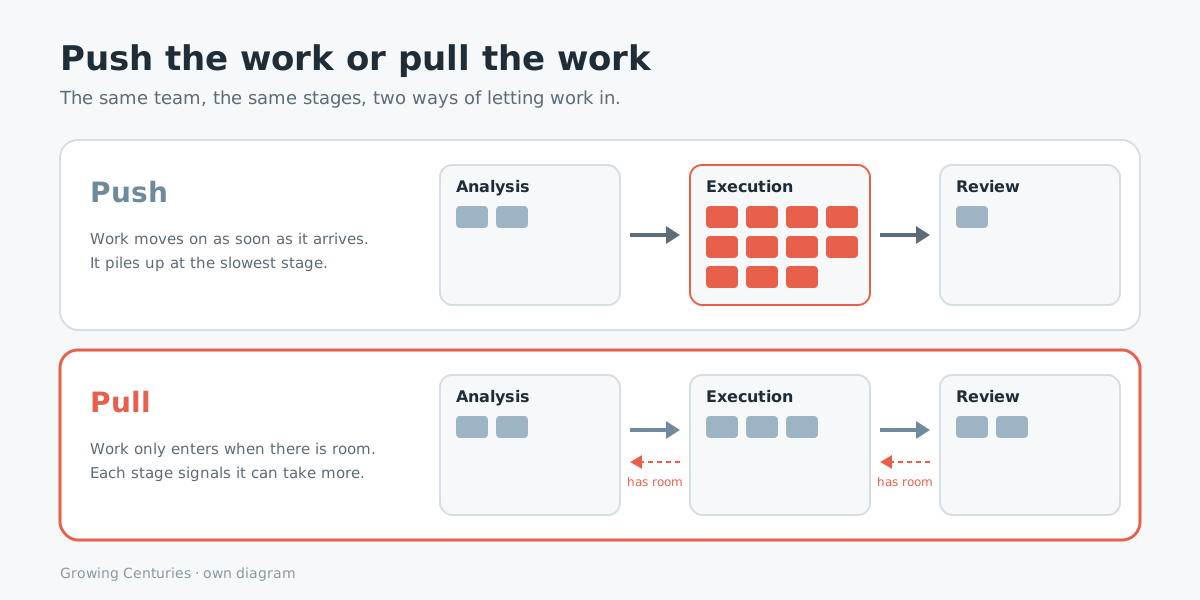
The inspiration came from supermarkets, which Toyota began studying in the late 1940s. On a shelf, you only restock what the customer has taken. In the factory, each stage started producing only what the next stage asked for.
This is called pulling the work, instead of pushing it.
Decades later, David J. Anderson took these ideas into knowledge work. In 2010 he published the book Kanban: Successful Evolutionary Change for Your Technology Business, which gave the Kanban Method its shape.
His problem was not parts in a warehouse. It was teams with too many things started and too few finished. Today, the official guide to the method is maintained by Kanban University.
What problem it solves
Three situations you will probably recognise.
- Everything is urgent. Every request arrives as top priority. The team jumps from task to task and nobody knows what really comes first.
- A lot started, little finished. Everybody is busy. Even so, deliveries slip and simple requests take weeks.
- Nobody knows where the work is. Answering “how is that going?” takes a meeting, three messages and a good memory.
These situations have one thing in common. The work is invisible, and so more comes in than the system can finish.
How it works
The starting point is a board. Each column is a stage of the work. Each card is a request.
What makes the difference is the limits. Each stage has a maximum number of cards in progress, known as the WIP limit (work in progress).
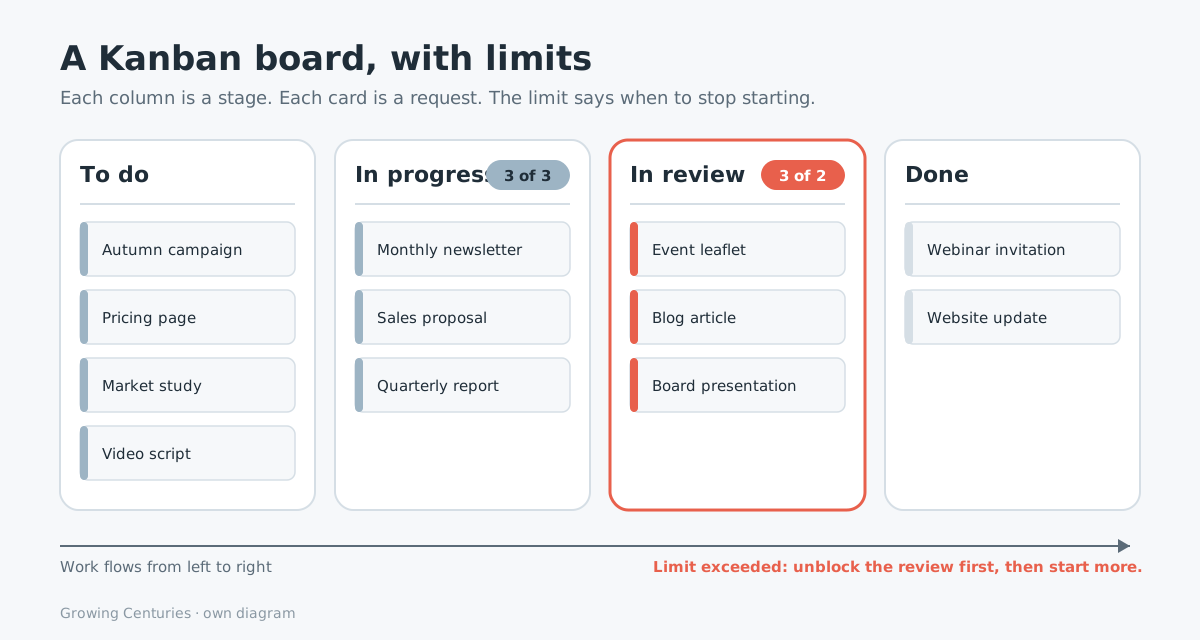
When a column reaches its limit, nothing else comes in. The team stops starting and starts finishing.
The method is organised into six general practices. They are not phases. They all run at the same time.
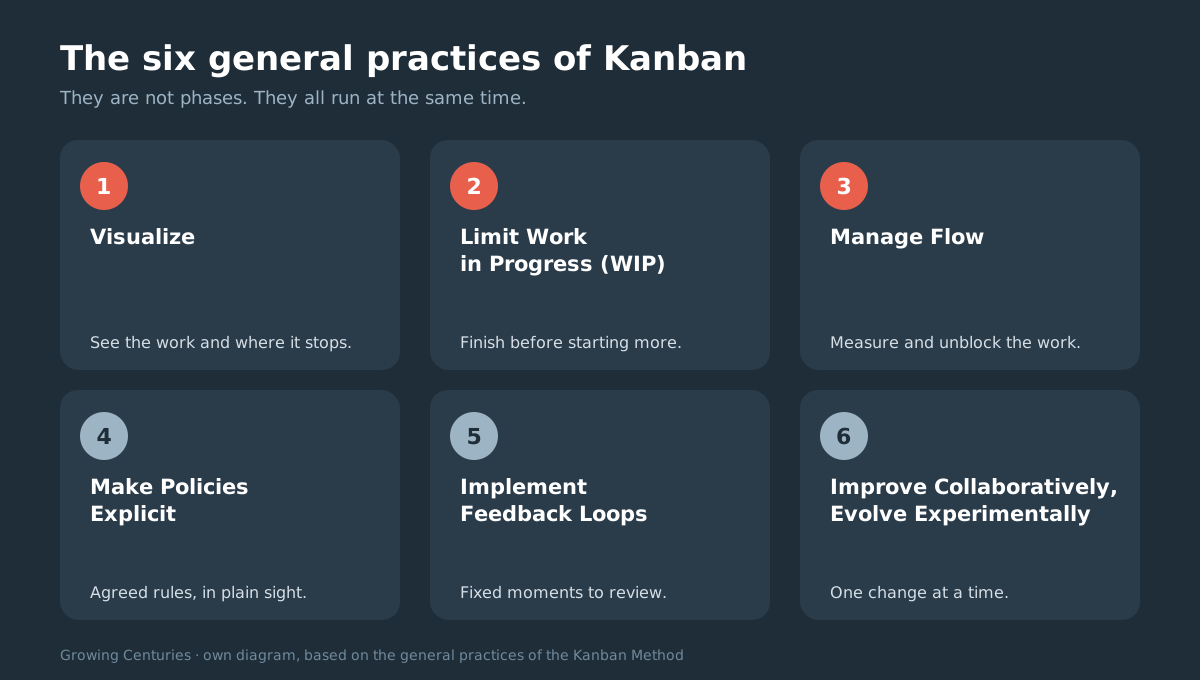
- Visualize. Put the work and its stages where everyone can see them.
- Limit Work in Progress (WIP). Agree how many things can be open at the same time.
- Manage Flow. Follow the journey of the work, not how busy people are.
- Make Policies Explicit. Write down the rules of the game: what comes in, what has priority, when something counts as done.
- Implement Feedback Loops. Set regular moments to look at the board and at the results.
- Improve Collaboratively, Evolve Experimentally. Change one thing at a time, together, and see what happens.
Behind the practices there are principles. Three of them say a lot about the spirit of the method:
- Start with what you do now. You do not throw away the current process. You start from it.
- Agree to pursue improvement through evolutionary change. Small steps, instead of one big reorganisation.
- Manage the work; let people self-organize around it. Attention goes to what is stuck, not to who is idle.
There is also one measure that almost every team ends up using: the time a request takes from the moment the team commits to it until it is delivered. This is called lead time.
An example
Note: this is an illustrative scenario, built to explain the practice. It does not describe a specific client.
Picture a marketing team of five people. It receives requests from sales, from senior management and from product. Everyone has a lot to do, and every request seems late.
One morning, they put everything on a board with four columns: to do, in progress, in review, done. They count the cards in progress. There are nineteen, for five people.
They agree a limit: no more than two cards in progress per person. The rest go back to the “to do” column, in priority order.
Three weeks later, the board shows something else. The “in review” column is always full. Cards sit there for days, waiting for the director’s approval.
Nobody was doing a bad job. The work was stopping in a place nobody could see.
The solution was a simple policy, written on the board itself: the director reviews cards on Tuesday and Thursday mornings. And the review column now has a limit of three.
What it is not
- It is not just a board with sticky notes. The board is the visible part. Without limits and agreed rules, it is only a to-do list on the wall.
- It is not only for software. It took shape in technology teams, but it applies to any service: marketing, human resources, legal, operations.
- It is not a digital tool. An app with columns helps. It does not have the difficult conversations about priorities for you.
- It is not a new process to implement. It does not tell you to throw away what exists. It starts with what the team already does and improves from there.
- It is not the relaxed version of another method. Limiting work in progress takes discipline, and it means saying “not yet” to the people asking.
The most common mistake is to stop at the first practice. The team visualises everything, limits nothing, and the board ends up showing the chaos in more colours.
Where to start
Draw the board with the stages your team’s work already goes through today, exactly as they are. Then count the cards in progress and agree a limit, even an imperfect one, to try for a month.
At Growing Centuries, the Kanban training is hands-on from start to finish. You work on your own context and leave with a system designed, not just with the theory explained. The trainer holds the KMP I and II credentials from Kanban University.
- Training page: Kanban at Growing Centuries
- Official site: kanban.university
Want to find out whether Kanban makes sense for your team? Get in touch.