What is Management 3.0
By Ricardo Fernandes ·

It is not a new management method. It is a different way of answering the question “who manages what”.
What it is, in two sentences
Management 3.0 is an approach to leadership built on one simple idea: manage the system, not the people. Instead of controlling what each person does, the leader looks after the conditions in which the team works, decides and learns.
It is not just a certification for bosses. It is not a new org chart.
It is a set of principles and concrete practices that anyone on the team can use.
Where it comes from
The name comes from the book Management 3.0: Leading Agile Developers, Developing Agile Leaders, published by Jurgen Appelo in 2010.
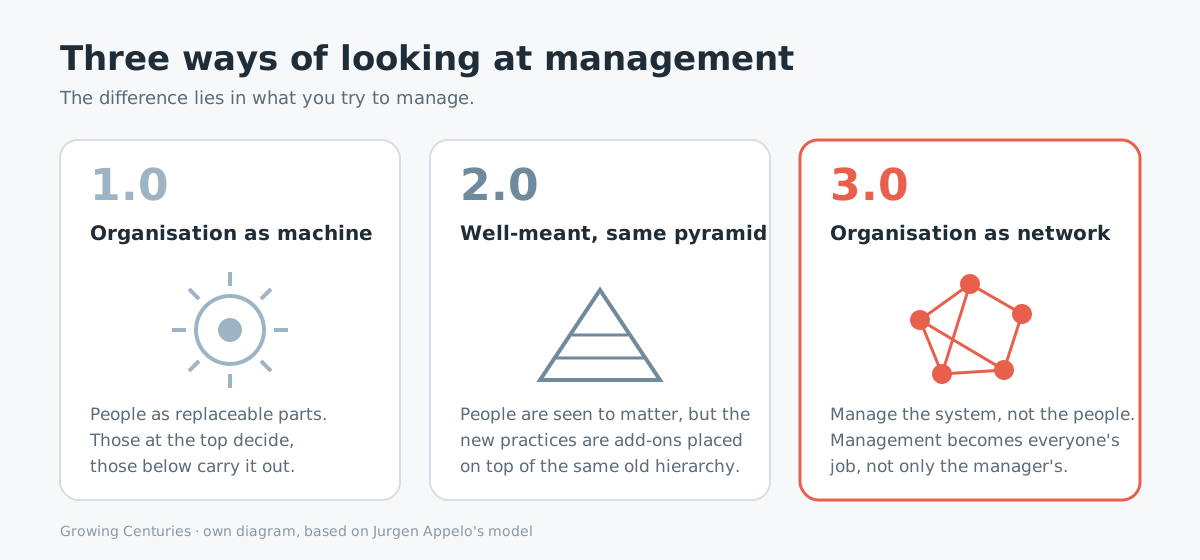
Appelo started from something many people in agile teams recognised. Teams were changing the way they worked. The management around them stayed the same. And often management itself was the biggest obstacle.
His answer was to look at organisations as complex systems, made of people and relationships, and not as machines. In 2016 he published a second book, Managing for Happiness, more focused on day-to-day practices.
The “3.0” makes sense once you see what came before.
What problem it solves
Three situations you will probably recognise.
- The leader is the bottleneck. Every decision goes through one person. The team waits. The leader has no time left to think.
- Autonomy was announced, but nobody knows the limits. The team heard “you are autonomous”. At the first serious decision, someone higher up overturns it. After that, nobody takes a risk.
- Motivation is handled with rewards. Bonuses, vouchers, annual events. The enthusiasm lasts a week and the underlying problem is still there.
These situations have one thing in common. People try to fix the people, when what needs to change is the system they work in.
How it works
The model is organised into six views. They are not steps. They are six angles on the same team.
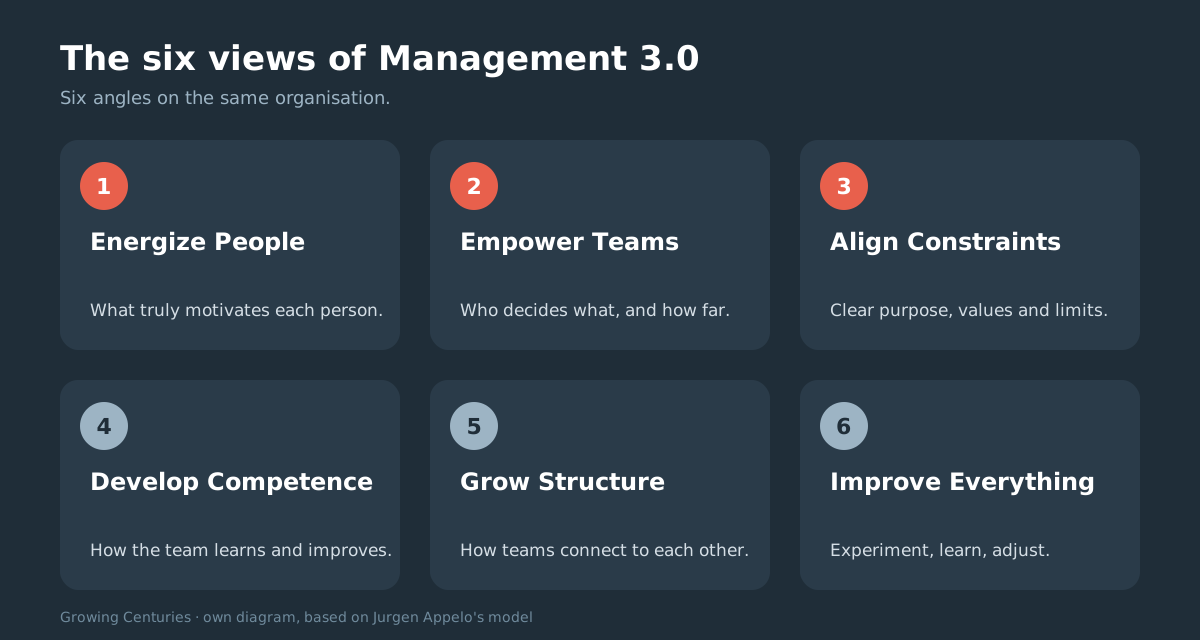
- Energize People. Understand what motivates each person, instead of assuming it is the same for everyone.
- Empower Teams. Make explicit who decides what, and with how much autonomy.
- Align Constraints. Give clear purpose, values and limits, so that autonomy has direction.
- Develop Competence. Create the conditions for the team to learn, instead of relying only on one-off training.
- Grow Structure. Design how teams connect, so that communication flows.
- Improve Everything. Treat change as a sequence of experiments, learning along the way.
Each view comes with its own practices. Some of the best known:
- Moving Motivators. Ten cards to talk about what motivates each person.
- Delegation Poker and Delegation Board. A game and a board to agree the level of delegation for each type of decision.
- Kudo Cards. Recognition between colleagues, in writing and in the moment.
- Celebration Grid. A board to tell avoidable mistakes apart from experiments that were worth the learning.
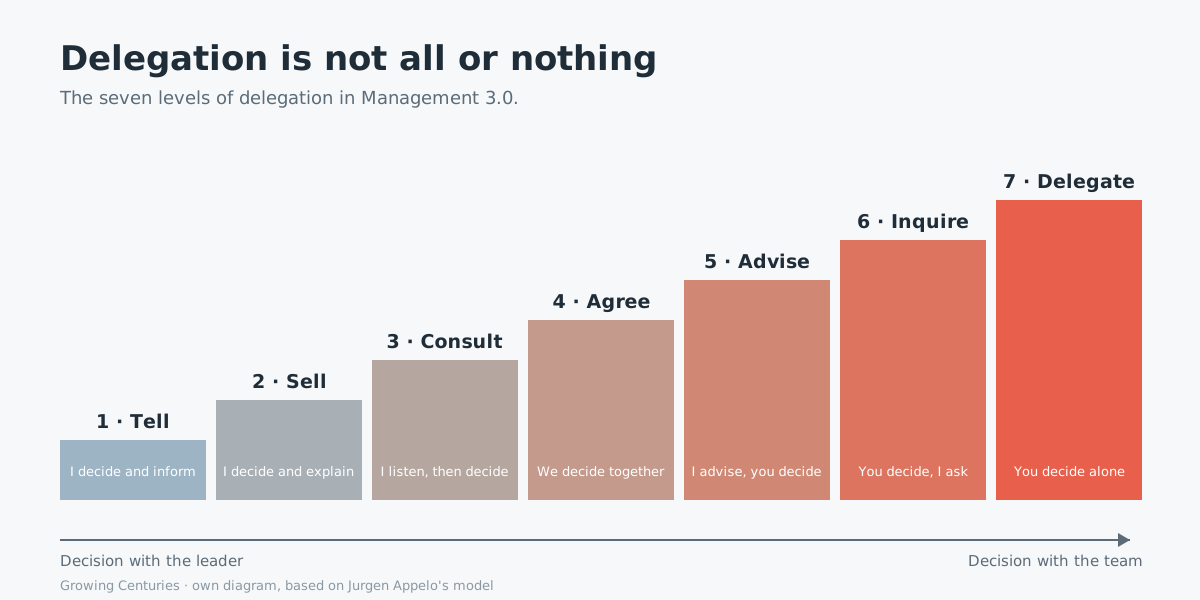
The idea that most surprises newcomers is delegation. Delegating is not an on/off switch. There are seven levels between “I decide” and “you decide”.
An example
Note: this is an illustrative scenario, built to explain the practice. It does not describe a specific client.
Picture a product team of eight people and a director who approves everything: holidays, priorities, hiring, technical choices. The team complains about a lack of autonomy. The director complains about a lack of initiative.
In a two-hour session, they list their ten most frequent decisions. For each one, everybody shows a card from 1 to 7 at the same time.
The differences show up immediately. For technical choices, the director shows a 6. The team shows a 3. She thought she had already delegated. They thought they needed permission.
Nobody was acting in bad faith. The agreement simply had not been made visible.
At the end, there is a board on the wall with the agreed level for each decision. When a doubt comes up, people check the board instead of booking a meeting.
What it is not
- It is not the end of managers. The role changes. It stops being about deciding everything and becomes about looking after the system.
- It is not only for software. It was born in the agile world, but it applies to any team doing knowledge work.
- It is not a collection of games. The practices are fun, and that is the risk. Without the principles behind them, Kudo Cards are just colourful sticky notes.
- It is not a framework to implement. There is no certified end state. You pick a practice, try it, adjust.
The most common mistake is to start with the tools and skip the difficult conversation. Delegation Poker only works if the leader is willing to honour what was agreed.
Where to start
Pick a single practice and try it with your team for a month. Delegation is usually a good starting point, because it touches a problem almost every team has.
At Growing Centuries, the Management 3.0 training is hands-on from start to finish. You leave having tried the tools, not just having heard about them. The next dates are on the training page.
- Training page: Management 3.0 at Growing Centuries
- Official site: management30.com
Want to find out whether Management 3.0 makes sense for your team? Get in touch.