What is SAFe® and when it makes sense
By Ricardo Fernandes ·
It is not a way of making a team agile. It is a way of getting many teams to pull in the same direction, and not every organisation needs that.
What it is, in two sentences
SAFe® (Scaled Agile Framework) is a set of roles, events and rules for coordinating many teams that work on the same product or service. It gets those teams to plan together, deliver at the same pace and answer to shared priorities.
It is not a replacement for Scrum or Kanban.
It is a coordination layer that sits on top of teams that already work in an agile way.
Where it comes from
SAFe was created by Dean Leffingwell. The core ideas appear in his 2007 book Scaling Software Agility, and the first version of the framework was published in 2011.
Agile methods worked well with one small team. In companies with hundreds of people building the same system, nobody quite knew how to fit the pieces together.
Today the framework is maintained by Scaled Agile, Inc., which also runs the training and the certifications.
What problem it solves
Three situations you will probably recognise.
- Every team hits its plan, and the product is late anyway. Each team delivers its part. What fails is putting the parts together, and that only shows at the end.
- Dependencies show up late. Team A needs something from team B. Team B only finds out halfway through, when its schedule is already full.
- Strategy does not reach the teams. Senior management sets yearly priorities. Teams decide their work every two weeks. Between the two, there is no visible link.
The problem is not inside any one team. It is in the space between them.
How it works
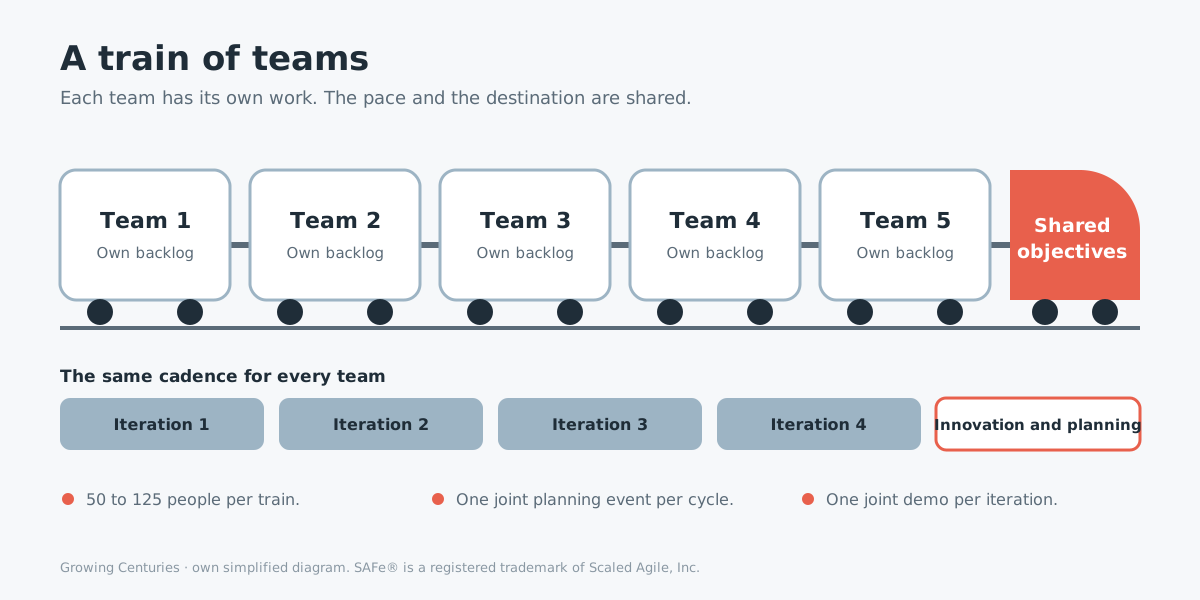
The central image in SAFe is a train: several teams on the same track, moving at the same pace.
The main concepts:
- Agile Release Train (ART). A stable group of teams, usually between 50 and 125 people, that builds and delivers the same product or solution.
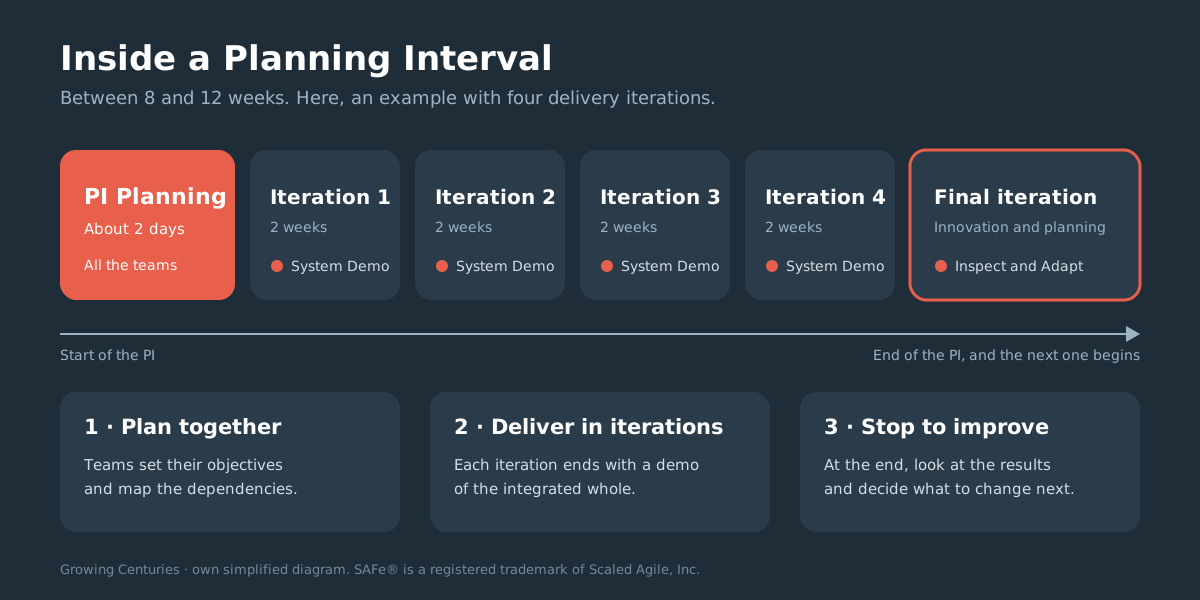
- Planning Interval (PI). A cycle of 8 to 12 weeks with objectives shared by the whole train.
- PI Planning. An event, typically two days long, where all the teams plan the PI together and make dependencies visible.
- Iterations. Short, fixed-length periods, usually two weeks, in which teams deliver finished work.
- System Demo. A demonstration of the work of all the teams, already integrated.
- Inspect and Adapt. A moment at the end of the PI to look at the results and decide what to improve.
- Release Train Engineer (RTE). The person who facilitates the train and removes the blockers no single team can solve.
All of this fits into a rhythm that repeats.
The framework has four configurations, from the simplest to the most complete:
- Essential SAFe. The minimum: one train, its teams and its events. This is where you start.
- Large Solution SAFe. For solutions so large that they need several coordinated trains.
- Portfolio SAFe. Connects strategy and budget to the work of the trains.
- Full SAFe. Combines the other three.
Most organisations never need to go beyond the first.
When it makes sense, and when it does not
SAFe is a big investment, in training, in time and in change. It pays to have criteria before you decide.
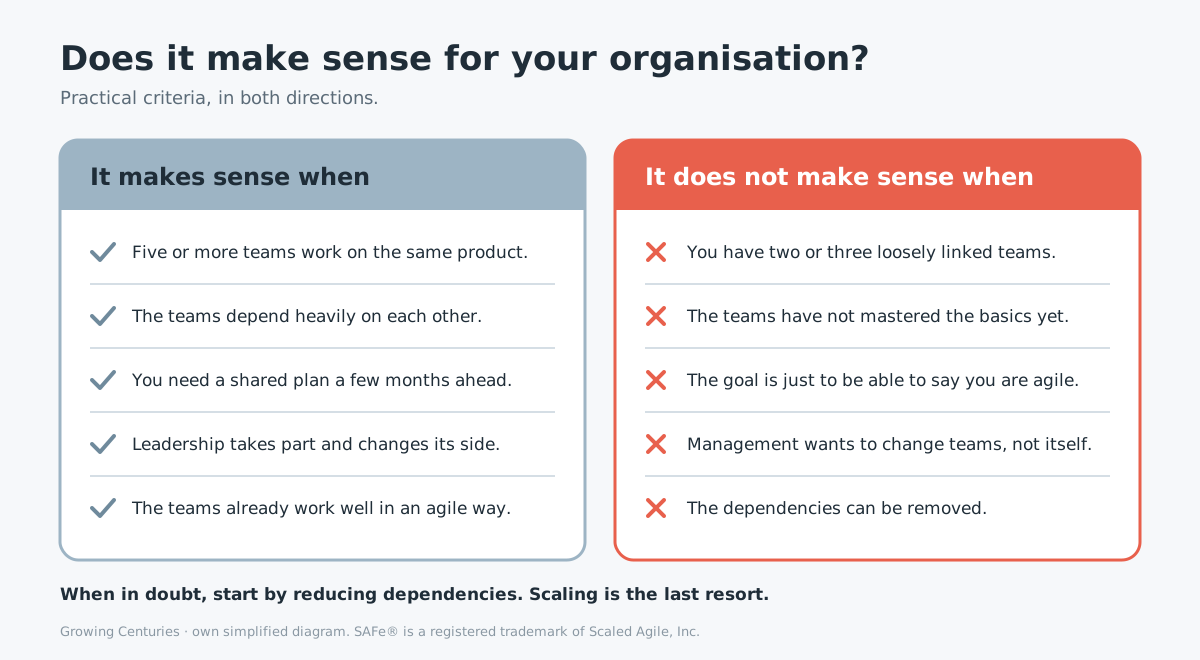
It makes sense when:
- Many people work on the same product. Five or more teams touching the same system, with deliveries that depend on each other.
- The dependencies cannot be removed. You have already tried reorganising the teams and the architecture, and there is still work that cuts across several of them.
- The business needs predictability a few months ahead. There are commitments to customers or regulators that do not fit into two weeks.
- Leadership is willing to take part. SAFe asks management to change how it sets priorities and funds the work.
It does not make sense when:
- You have two or three teams. Coordination can be handled with regular conversations. A whole framework is too much weight.
- The teams have not yet mastered the basics. Scaling teams that do not deliver well only multiplies the problems.
- The goal is to be able to say the company is agile. The names of the meetings and the job titles change. Everything else stays the same.
- The teams can be independent. If you can design teams that deliver on their own, that is almost always the better choice.
The criticisms of SAFe are well known. It is said to be heavy and prescriptive, with too many roles and ceremonies. To keep the same old hierarchy under new vocabulary. To reduce team autonomy through planning months ahead, in a way that resembles the rigid plans the agile movement set out to leave behind.
These criticisms describe top-down rollouts well, where the whole framework is installed in one go. They describe less well the ones that start with a single train and only add what solves a concrete problem.
SAFe does not fix a command-and-control culture. Applied to one, it just makes it better organised.
An example
Note: this is an illustrative scenario, built to explain the practice. It does not describe a specific client.
Picture a company with seven teams, about seventy people, working on the same lending platform. Each team has its own calendar, and the directors meet every week to manage delays.
They decide to try a single train, and nothing else.
At the first PI Planning, they bring everyone together for two days. Each team plans its iterations and sticks on a shared board what it needs from the others.
By the end of the first afternoon, the board shows what nobody had seen. Four teams depend on the integrations team in the same iteration.
The decision is made there and then, with the right people in the room. Two features move to the next PI. One team lends a person to the integrations team for a month.
The difference is that the problem surfaced in week one, and not in week ten.
What it is not
- It is not agile at large scale. An organisation does not become agile by adopting SAFe. It becomes better coordinated. Those are different things.
- It is not meant to be installed in full. The complete picture is impressive, and that is the risk. Almost nobody needs all of it.
- It is not a shortcut. It does not replace competent teams, good technical practices and leaders who change their own behaviour.
The most common mistake is to start with the org chart and the certifications, and leave the essential question for later: what problem are we trying to solve?
Where to start
Before any training, do a simple exercise. List the last five deliveries that were late and write down the cause of each. If most of them point to dependencies between teams, SAFe is worth getting to know. If not, the problem lies elsewhere.
At Growing Centuries, the Leading SAFe® training is hands-on. You work through planning simulations, so that you leave with criteria for deciding and not just with vocabulary. It also gives you access to the Scaled Agile certification exam.
- Training page: Leading SAFe® at Growing Centuries
- Official site: framework.scaledagile.com
Want to find out whether SAFe makes sense for your organisation? Get in touch.