What is unFIX
By Ricardo Fernandes ·

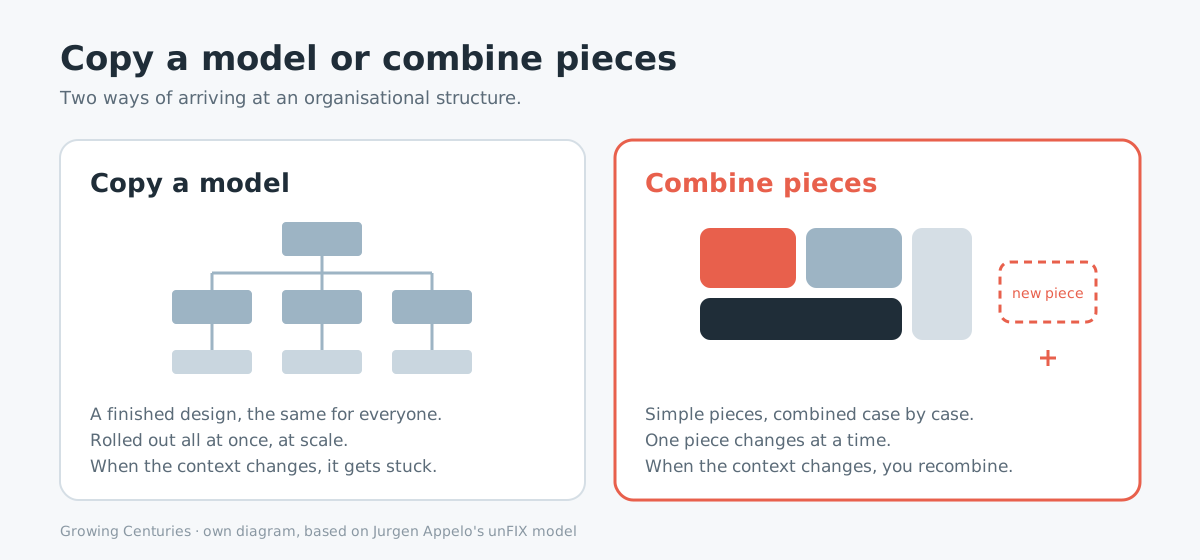
It is not one more organisational model to copy. It is a box of pieces for designing your own.
What it is, in two sentences
unFIX is a pattern library for designing organisations: types of team, ways of grouping them and ways of connecting them. Instead of handing over a finished org chart, it offers simple pieces that each company combines in its own way, and recombines when the context changes.
It is not a framework. It comes with no processes, no ceremonies and no implementation plan.
The comparison used on the official site is LEGO. The pieces are the same for everyone. What you build with them is not.
Where it comes from
The model was published in January 2022 by Jurgen Appelo, the author of Management 3.0.
Appelo wanted an alternative to the closed models that companies tend to copy, such as SAFe, LeSS, Holacracy or the so-called Spotify model. In his reading, those models arrive as a static package. And an organisation needs to reorganise often, in small steps.
He says himself that the ideas are not new. They come from work such as Team Topologies and Dynamic Reteaming. What is new is the visual language and the names given to the pieces.
The name explains the intent. It reads as “unfixing” the organisation, making it less rigid. The letters I and X stand for Innovation and eXperience.
What problem it solves
Three situations you will probably recognise.
- The reorganisation that never ends. Every two years there is a new org chart. The project takes months. By the time it is finished, the market has moved again.
- The copied model. The company adopted someone else’s names: squads, tribes, release trains. The boxes got new labels. The dependencies and the queues stayed the same.
- The matrix with two bosses. Each person reports to a functional lead and a project lead. When priorities clash, nobody knows who decides.
These situations have one thing in common. Structure is treated as a project with an end date, when it should be something you adjust little by little.
How it works
The best-known part of unFIX is structure. It rests on three pieces.
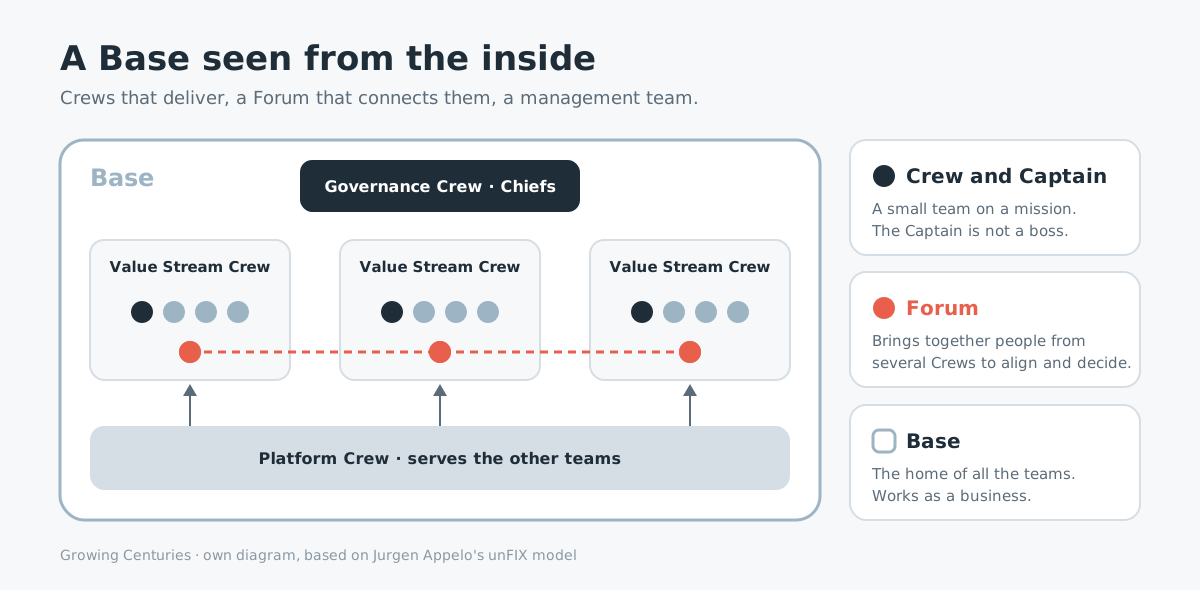
- Crew. A small team with a mission and a defined goal, usually three to seven people.
- Base. The “home” of the teams: the group people belong to and return to after each mission. It can range from a single team to a few hundred people, and it works as a complete business.
- Forum. A place where people from several Crews talk and decide together, for example about ways of working or shared tools.
There are also Turfs, areas of work looked after by the same group of people. To get started, the first three pieces are enough.
Not all Crews are alike. The model distinguishes seven types, depending on the role the team plays.
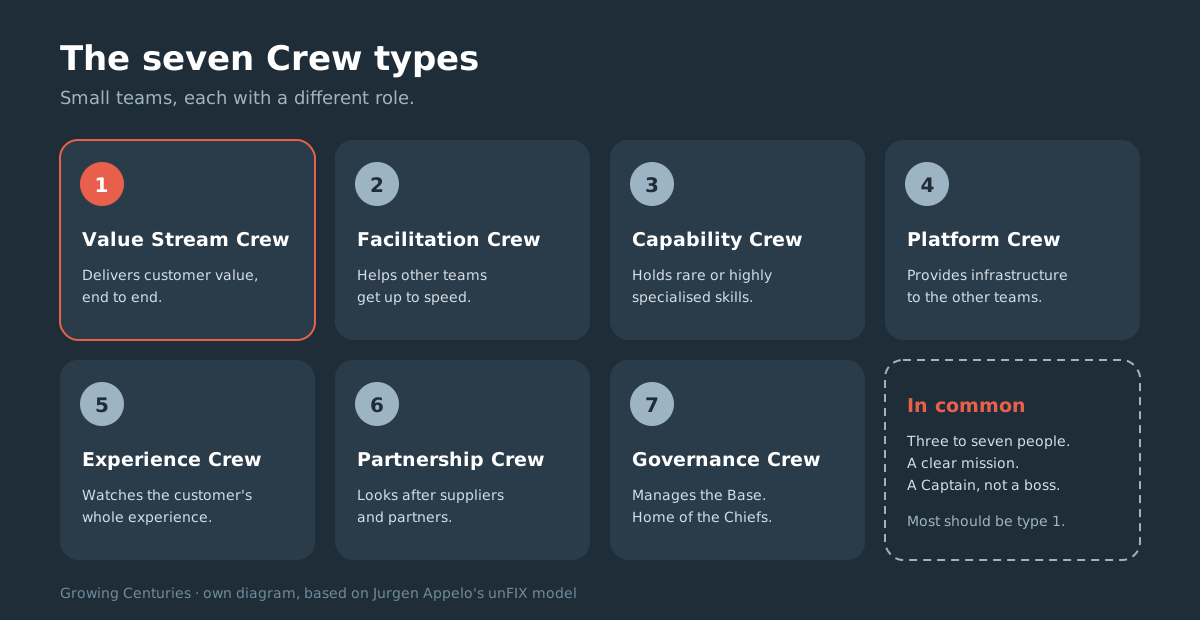
- Value Stream Crew. Delivers value to the customer end to end. In an ordinary company, most teams should be of this type.
- Facilitation Crew. Temporarily helps other teams get up to speed.
- Capability Crew. Holds rare or highly specialised skills.
- Platform Crew. Provides infrastructure to the other teams, like an internal supplier.
- Experience Crew. Watches over the customer’s whole experience, beyond any single product.
- Partnership Crew. Does the same for those on the outside: suppliers, partners and freelancers.
- Governance Crew. The management team of the Base.
Three roles name whoever leads each piece. The Captain is the point of contact for a Crew. The Chair moderates a Forum. The Chiefs are part of the Governance Crew.
The important difference lies in line management. Neither the Captain nor the Chair is anybody’s boss. People management sits in the Governance Crew, and there is no middle management.
Beyond structure, the library has other pattern sets: on teaming, decision-making, goal-setting and processes.
An example
Note: this is an illustrative scenario, built to explain the practice. It does not describe a specific client.
Picture a software company of sixty people, organised by department: development, design, quality and support. Every new feature goes through four queues. Nobody follows the work from start to finish.
The leadership does not draw a new org chart. It starts with a question: if the company were a single Base, which pieces are already there?
The first experiment is small. A Value Stream Crew of six people is formed, with all the skills it needs, dedicated to one of the two products. They choose a Captain. The rest of the company stays as it is.
A few weeks later, a predictable effect appears. The designers, now spread out, start making different decisions about the same things. Instead of rebuilding the department, they create a design Forum that meets every two weeks.
Three months later, they repeat the step for the second product. The shared infrastructure moves to a Platform Crew.
Nobody announced a transformation. One piece changed at a time, and each change was treated as an experiment.
What it is not
- It is not a framework to implement. There is no end state and no single right design. There are pieces and possible combinations.
- It is not only for technology. The language grew up close to the agile world, but the pieces describe any organisation.
- It is not the end of management. People management still exists. It is concentrated in the Governance Crew, instead of spread across middle layers.
- It does not replace what already works. If your company uses Scrum, Kanban or OKRs, unFIX does not throw them out. It gives you a vocabulary for the structure around them.
The most common mistake is to change the names and nothing else. Calling a department a Crew does not change the queues. What changes things is giving a team end-to-end responsibility.
Where to start
Draw your current organisation using the unFIX pieces. For each team, ask which type of Crew it is. Where the answer is unclear, you have found the first conversation to have.
At Growing Centuries, the unFIX training is hands-on from start to finish. You work with the pieces on a concrete case, instead of stopping at the theory. The next dates are on the training page.
- Training page: unFIX at Growing Centuries
- Official site: unfix.com
Want to find out whether unFIX makes sense for your organisation? Get in touch.