What is agile leadership
By Ricardo Fernandes ·

It is not a job title or a method. It is a way of leading when it is no longer possible to have all the answers.
What it is, in two sentences
Agile leadership is a way of leading designed for fast-changing contexts, where whoever leads can no longer plan everything or have all the answers. Instead of deciding and controlling every step, the leader sets the direction, creates the conditions for the team to decide well and adjusts course with what is learned along the way.
It is not a job title. It is not a methodology with rules and a certificate.
It is how a leader thinks, decides and communicates, whatever method the team uses.
Where it comes from
The word “agile” comes from the Manifesto for Agile Software Development, written in February 2001 by seventeen practitioners. The manifesto has four values and twelve principles. One of them asks for projects to be built around motivated individuals, given the environment and support they need, and trusted to get the job done.
In the years that followed, many teams changed the way they worked. The way they were led often stayed the same. It soon became clear that the change did not last if the leadership around it kept working through command and control.
Agile leadership has no single author and no official body. It brings together ideas from several sources: servant leadership, described by Robert K. Greenleaf in 1970; Daniel Pink’s work on motivation, built on autonomy, mastery and purpose; and approaches such as Jurgen Appelo’s Management 3.0.
Today it is used well beyond software: in marketing, human resources, operations, healthcare and public services.
What problem it solves
Three situations you will probably recognise.
- Everything goes through the leader. Every decision, however small, waits for one person. The team stops. The leader has no time to think about what comes next.
- The plan no longer fits, but it still rules. The annual plan was made in January. By March, the context had changed. The team knows, but keeps following the plan, because that is what gets measured.
- The team delivers, but does not commit. It does what it is asked, no more and no less. Ideas go unsaid, because last time nobody listened.
These three situations have something in common: leadership was designed for a predictable world, and the world around it stopped being predictable.
How it works
Agile leadership rests on a simple exchange. The leader stops saying how to do things and starts making the what and the why clear. The team decides the how, within agreed boundaries.
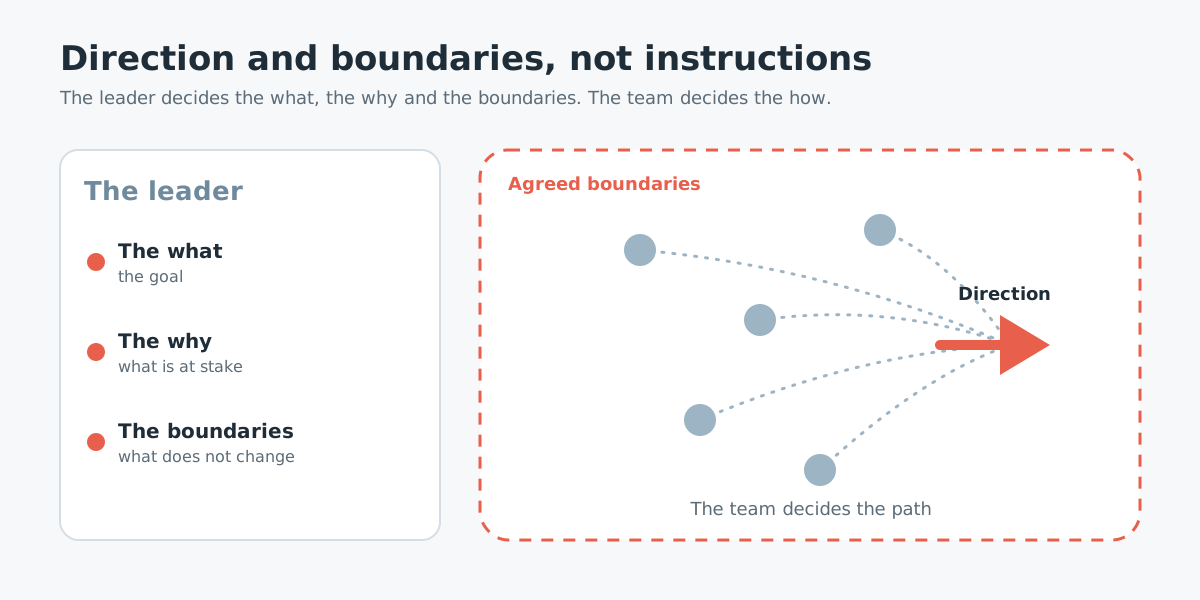
In practice, this comes down to five habits.
- Give direction, not instructions. Explain the goal, the why and what counts as success. Leave the path open.
- Make the boundaries explicit. Say what is not negotiable: budget, deadlines, rules, values. Within them, the team decides.
- Agree who decides what. Autonomy is not all or nothing. Some decisions stay with the leader, some are made together and some move to the team.
- Work in short cycles and learn from them. Deliver in short cadences, look at the result and adjust, instead of waiting until the end to find out what went wrong.
- Make it safe to speak up. Ask for objections, thank people for bad news and treat mistakes as information.
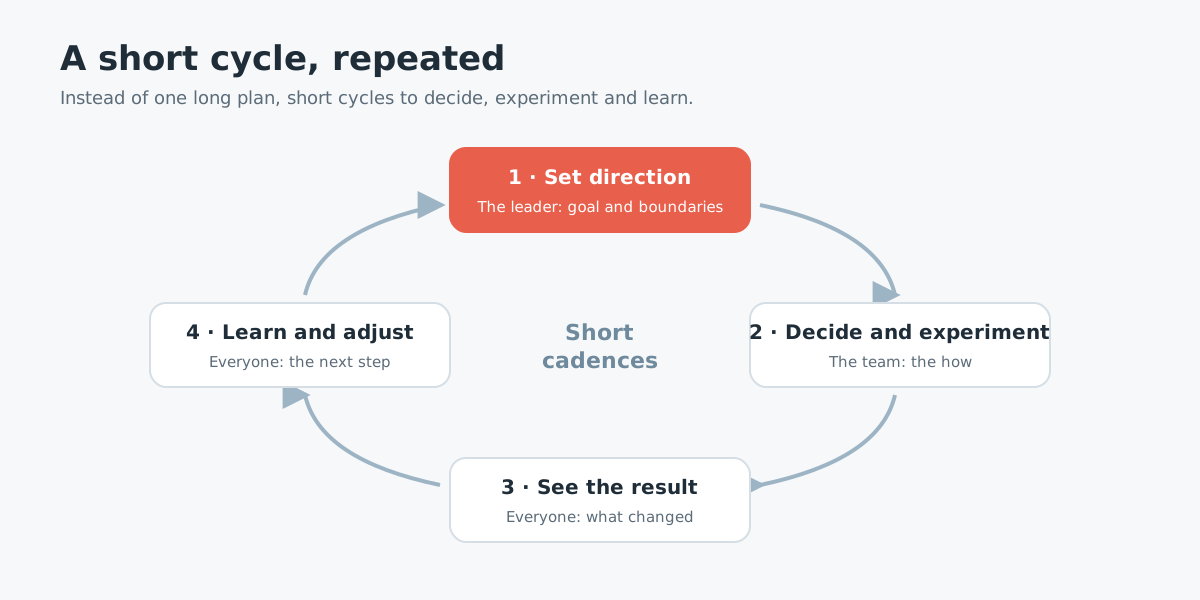
The leader still decides. They decide fewer things, but they decide the ones only they can decide: direction, priorities, boundaries and people.
An example
Note: this is an illustrative scenario, built to explain the practice. It does not describe a specific client.
Picture an operations manager with a team of twelve in a customer support centre. Response times are going up. The usual reaction would be to write a new procedure and ask for daily reports.
This time, she brings the team together for an hour. She shows the number that worries her, explains why and says what cannot change: opening hours and budget. Then she asks: “What would you change over the next two weeks to bring this number down?”
The team proposes three experiments. They pick one: separating simple requests from complex ones as soon as they come in. They agree to look at the results after two weeks.
By then, simple requests are resolved faster. Complex ones are still slow. The team proposes the next experiment.
The manager did not stop leading. She chose the problem, set the boundaries and followed the results. She only stopped deciding the how on her own.
What it is not
- It is not leaving the team on its own. Autonomy without direction or boundaries is abandonment. Agile leadership asks for more presence, not less.
- It is not only for software teams. It grew up close to the agile world, but it suits any team working in an uncertain context.
- It is not a personality trait. You do not need to be outgoing or charismatic. These are habits you can learn and practise.
- It is not doing away with hierarchy. Roles still exist. What changes is how they are used.
The most common mistake is to announce autonomy without saying where the boundaries are. At the first decision that goes wrong, the leader takes control back, and the team learns that the autonomy was in name only.
Where to start
Pick one decision you make on your own today that the team could make. Tell the team what the goal is and what the boundaries are, and let them decide for a month. At the end, talk about what went well and what you would adjust.
At Growing Centuries, the Agile Leadership in Practice training starts from real leadership situations, not abstract theory. The next dates are on the training page.
- Training page: Agile Leadership in Practice at Growing Centuries
- To go further: What is Management 3.0 and the Agile Manifesto
Want to understand what kind of leadership your team needs right now? Get in touch.